Showing posts with label Reprint. Show all posts

Sunday, February 19, 2012

Reprint: Interview With Diane Noomin, 1995

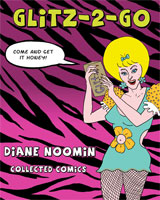
It is a cause for great celebration that Fantagraphics Books has now released Glitz-2-Go, the overdue collected comics of Diane Noomin, long one of my favorite cartoonists. Artists like Noomin, Kim Deitch, Aline Kominsky-Crumb, Justin Green, and Noomin's husband, Bill Griffith, were an important bridge between the profane antics of the underground cartoonists of the 1960s and the later, more personal and often autobiographical work which became prevalent in the alternative comics of the 1980s and 90s.These artists' comics appeared in a broad range of now-defunct publications and obscure anthologies, so collections like this are especially welcome. You can see a preview and pdf sample for the new book here, but why not purchase it here, direct from the artist?

Diane Noomin's comics cover quite a bit of territory, from the broad (ha, ha) farce of her Didi Glitz stories to penetrating social satire and revealing autobiography. At her best, such as in her harrowing story of multiple miscarriages discussed below, she manages to combine all of the above approaches to devastating effect. This story alone makes this collection worth reading.

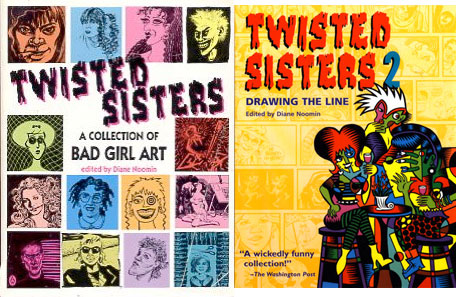
I interviewed Ms. Noomin for Hypno Magazine in 1995 via telephone, and later met her in person at the San Diego Comic Con. She had just finished editing a new series of Twisted Sisters comics, her influential anthology of female cartoonists, and was finalizing the collected volume, Twisted Sisters 2: Drawing the Line, so she was busy indeed.  Later, the magazine came out and the interview was so obnoxiously designed (a Hypno trademark) it looked like a computer had had a nervous breakdown, so I'm re-typing it here rather than subjecting you to ugly scans. The interview follows:

PH: You just finished both editing and contributing to the new Twisted Sisters anthology for Kitchen Sink Press. Was that a tough juggling act?

DIANE NOOMIN: Yes, it was really tough. It's really hard to be an editor of your peers and a cartoonist at the same time. I had to wear a lot of different hats. It was hard, especially, since the first Twisted Sisters was work that had already been in print, so it was just a question of finding stuff I liked and getting permission to use it. There was a lot of work involved, but I didn't have to worry about hassling people about deadlines, or someone deciding that they wanted to do twelve pages instead of ten, or someone deciding to do only three pages when they had promised ten. There were more immediate and pressing problems... dealing with people's personal lives and trying to be sympathetic. I think I was somewhere between a den mother and a drill sergeant.

PH: Mary Fleener affectionately referred to you as an "editress," but also as a Jewish Earth Mother.

DN: [laughs] I don't know if that's about my hips, or what! I guess I'll take it as a compliment.

PH: Your new long story, "Baby Talk", is an excruciatingly personal tale of multiple miscarriages. Was it a cathartic experience to write it?

DN: At times it was. I may not know for a while, because I just finished it, and I'm still pretty close to it. I think that one of the reasons I did it was that I was hoping it would be a cathartic experience. It's interesting, because you find yourself choking up and getting really emotional about something, and then the artist part of you jumps in and says, "Great! I can use that!" There are a lot of powerful emotions involved, but you have to figure out how to not just vomit it out on the page, but turn it into something that people will respond to and want to read.

PH: Was it difficult to inject humor into that story?

DN: Surprisingly, it wasn't that difficult. I was worried about that. I really don't want to do something that people would think, oh, this is a whining story, and who cares, and it's just another story about women's bodily functions. I was really concerned about that. The humor came in when I decided to use Didi Glitz, with these intervals of me and Didi talking. That was a natural source of humor, and that was really fun for me and sort of a needed break.

PH: In the story, you begin with a fictional couple, and then Didi Glitz gets fed-up and literally pulls you from behind that mask and forces you to tell your own story, honestly, without fictionalizing it. Was that planned originally?

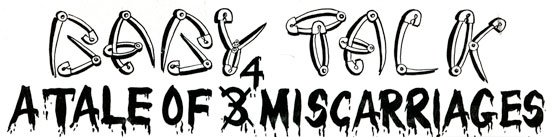
DN: [laughs] It wasn't planned. Actually, the story behind "Baby Talk" is that I tried to do that story off and on for a long time, and I think I had the first page-and-one-half for about five years, and I couldn't do it. I just couldn't face it. I wasn't really ready to do the story and deal with the subject of miscarriages. In fact, the subtitle of the story is "A Tale of [3 crossed out] 4 Miscarriages".

PH: Because in the meantime, since starting the story, you had...

DN: Another miscarriage. Finally, I knew it was what I wanted to do for the new Twisted Sisters, but I didn't want to do it the same way. I first wanted to do it indirectly, hiding behind Didi's sister as my fictional stand-in. I didn't want to do it that way anymore, but I didn't want to scrap the work I'd already done! [laughs] I did have some doubts and fears about coming out from behind the mask as well, so I incorporated that, too.

PH: It certainly makes the story more complex, narratively, than your earlier work.

DN: Well, it's fun. It's fun to play with that, the whole notion of being a cartoonist and "how real is your cartoon character?"

PH: It's amazing that you're telling this horrifying tale to Didi Glitz while doing her hair and painting her toenails!
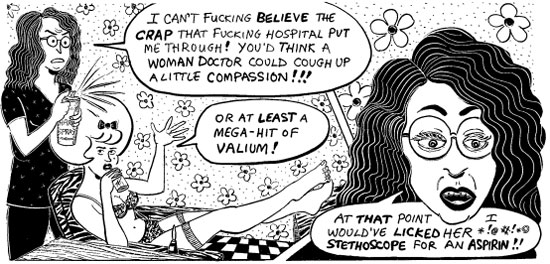

DN: Well, that's what I meant by breaking it up!

PH: It does, but it doesn't take away from the immediacy of the story, which is tremendously affecting.

DN: I'm glad. It was a very tricky juggling act to deal with something so personal and horrific, and turn it into something that people will want to read.

PH: Let's talk more about Didi Glitz. She's been around for roughly twenty years now. Can you tell me something about her origin?

DN: It's sort of complicated. The first Didi story appeared in Wimmen's Comix [Last Gasp, 1974], and it was "She Turned to Crime," where Didi robs a bank and goes to Rio. [laughs] I think she started out as a Halloween costume. I had this bubble wig and leopard skin outfit. I had a roommate at the time, Willie Murphy, a cartoonist, who called me Didi. It's really based on living in Brooklyn in the early 60s.
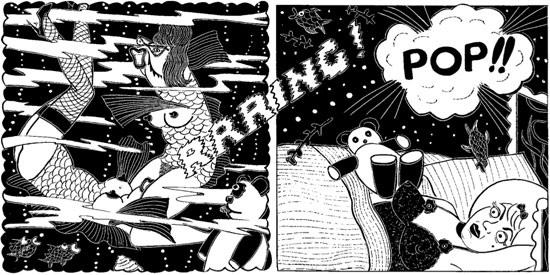

PH: Is Didi Glitz an alter-ego, or more of a foil to your personality?

DN: That's sort of complicated. She's an alter-ego in that she's very brash, and there's certainly a part of me that would have liked to stay in Brooklyn and eat bagels for the rest of my life. Didi is definitely very real, and a part of me, but she's also a way to create satire and comment on certain types of people, and women's roles and all that stuff.

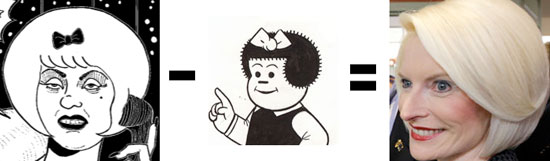
PH: Is that Nancy's bow on Didi's head?

DN: I never thought of that! [laughs] It looks like it could be. It's rigid enough.

PH: What's in a Golden Cadillac, Didi's favorite drink? Do you like them?

DN: It's Galliano, Triple Sec, and cream. Not bad as far as festive beverages go.

PH: How about Mai Tais? Didi guzzles plenty of those, too.

DN: Mai Tais are good. I like large drinks in coconut shells with umbrellas and pineapple. I go for trimmings.

PH: How have you and your husband influenced each other? I noticed your swipe from his Zippy book Are We Having Fun Yet [Dutton, 1985] in your "I Had to Advertise for Love." [Young Lust, 1990]

DN: He did that earlier?

PH: Yes, the exact same pose (see below, Noomin on the left, Griffith on the right):
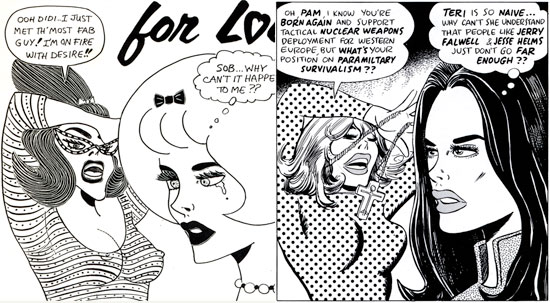

DN: Hmmm. I'll have to look it up.

PH: It wasn't intentional?

DN: No... that must be a subconscious influence.

PH: Well then, I guess that's a good example of how you influence each other!*

DN: Also, when we started going out, Bill was already an established cartoonist, and he took it real seriously, and he was at the drawing board being a complete workaholic, so just having someone around who was drawing all the time was a big influence on me getting serious about it.

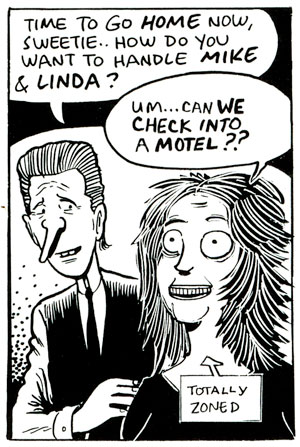
PH: Bill drew himself in "Baby Talk", and Didi made guest appearances in Zippy. Are you two planning on any further collaborations?

DN: We're not really planning anything. I guess sometimes it just happens. I asked him to do that in "Baby Talk". It just seemed like the right approach, because it was such a personal story, and it was his story as well. I did tell him what to draw and what to say! [laughs]
 

DN: But in terms of influencing him, I'll just say what I think, and if he wants to... Neither one of us are super great at taking criticism. You sort of pout for a while, and think about what they said, and end up changing it. We worked on the screenplay together for the Zippy movie.

PH: Ah, yes, the Zippy movie...

DN: On that level, I got very involved with his work. I was writing the screenplay with him, and it was his characters, so that was very interesting. It's gone off and on for, I don't know, nine years or something.

PH: Do you think it will ever get made?

DN: I have no idea. It's possible. We've had many entertaining Hollywood meetings. At this point, I'm very skeptical.

PH: Is Didi Glitz in the screenplay?

DN: No, I wouldn't want to do that. I wouldn't want to throw it away. I have plans for her.

PH: Would you ever attempt to do a daily strip?

DN: I actually tried that for about a week-and-a-half, and I thought I'd have a nervous breakdown. It's very difficult. Just sitting there and having that pressure. It's kinda like writing a Zen haiku each time.

PH: At least it should be, unlike most daily strips.

DN: Unlike Marmaduke! [laughs]

PH: You mentioned earlier an affection for Family Circus.

DN: Well, it's grown on me. It's very surreal. Bill showed me a recent one where one of the kids was imagining himself as an old man, and he had a beard, but he still looked exactly the same!

PH: Your work, on the other hand, is often very sexually graphic. Any comments?

DN: It's kind of liberating the first time you do that; you sort of shock yourself, and then it's kinda fun.

PH: You get pretty extreme, what with Didi and her poodle!
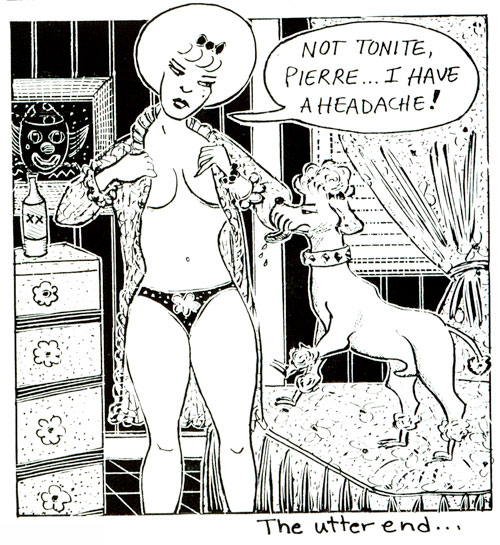

DN: That's part of the fun, to take it as far as you can. When you think about Didi, and you think about poodles, it's not all that unlikely.

PH: Do you consider yourself a feminist?

DN: I consider myself a feminist. Certainly there are people who won't, but I'm a feminist and I think it's good to do sexual material, and make fun of sex, and not think that there are certain bodily functions that we shouldn't talk about because we're feminists. I think that's... fucked up. I believe in the First Amendment extremely, and there are lots of things in print that I don't like, and I think are horrible... but there are a lot of people who don't like my work, and don't want to see it in print.

PH: Did you get any flack for "Lesbo a Go Go", in which Didi is seduced by a lesbian, and it all turns out to be a cruel trick?

DN: No. [laughs] I didn't. I've had people ask, "How come there are no lesbians in Twisted Sisters?" and my first reaction is, well, how do you know there aren't? My second reaction is that I don't care who you fuck, I just care about how you draw!

Disclosures: Oh, hey, look at that! I'm surprised to see that my introduction to the original Hypno article, not included here, is quoted on the back of the new book, and credited to the magazine rather than to me, which is kind of funny because who remembers Hypno? Also, in the "WTF kind of small world do we inhabit" department, Diane's first husband is my current boss at the National Gallery of Art.

*Actually, looking at this years later, I'm positive they were probably both "swiping" from the same source. Also:
Thursday, June 02, 2011

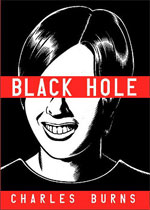
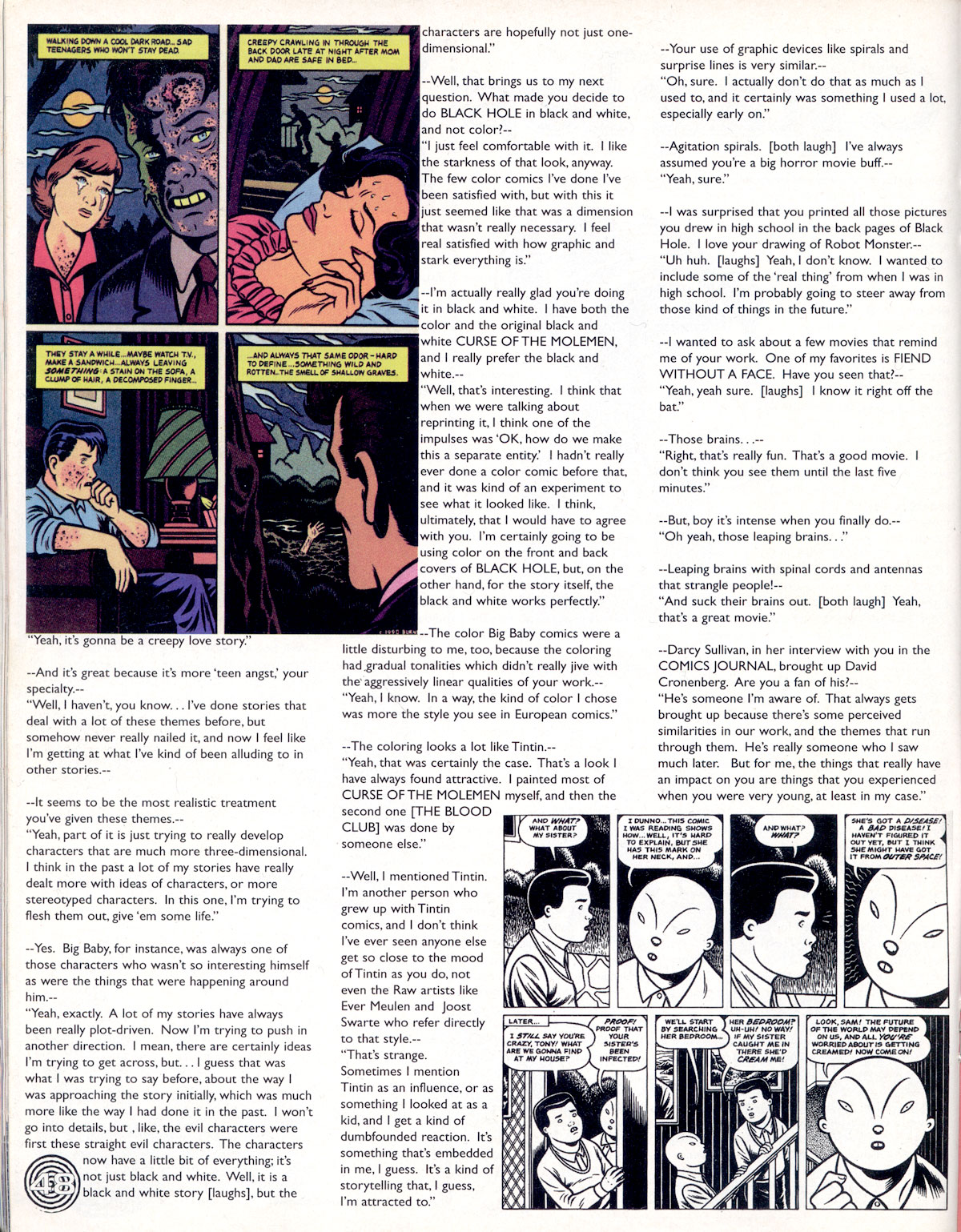
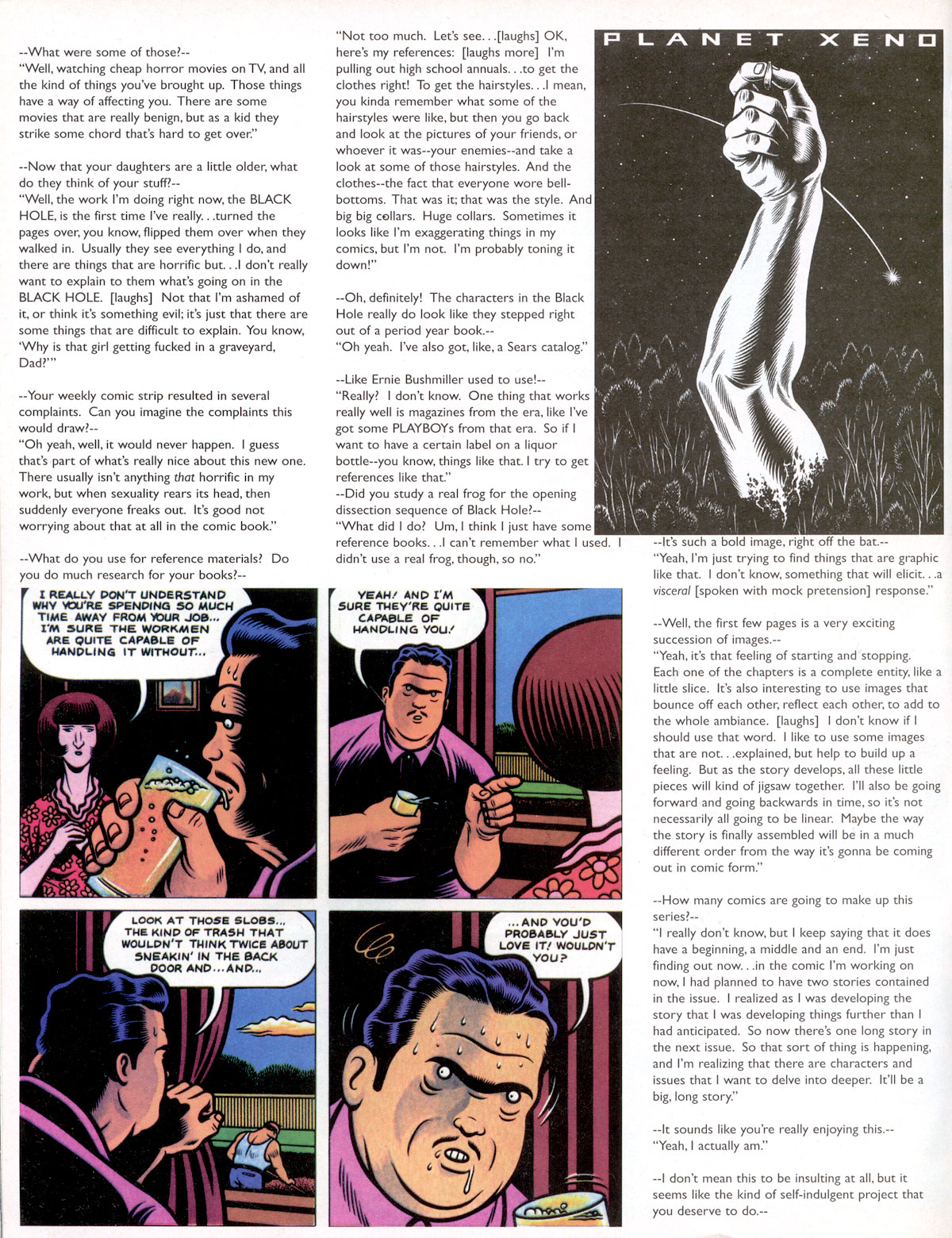
Reprint: Interview With Charles Burns, 1995

I conducted this interview with cartoonist Charles Burns in 1995 for Hypno Magazine. He had just started serializing his acclaimed graphic novel Black Hole, a project which would take a decade to complete, and that work is the focus of the interview. We spoke of the differences between Black Hole and his earlier work, his desire to do something totally self-indulgent after a prolonged period of concentrating on commercial illustrations (cartoonists need to eat, too), his working methods and the movies and comics which influenced him as a youth.

If you've never read his comics, I strongly suggest you do so, especially Black Hole, one of the most remarkable allegories of teenaged angst and fear ever published. His latest open-ended project, X'ed Out, is a beautiful melange of Tintin and... well, I'm not sure. William Burroughs? It's a stunning work, more abstract than Black Hole but as captivating as Dick Tracy at its most grotesque.

Over the years, Burns' skill as a draftsman just gets better and better. He eschews shading, preferring flat colors and crisp blacks and whites. There are rarely (if ever) any halftones in his work; all shading is accomplished with a skilfully brushed, comb-like "feathering" technique which makes other cartoonists blanch (I recall Mary Fleener openly admitting her jealousy to me, saying something like, "I don't know how he does it. It's like he's not human.").

Click on the following pages for big, legible scans:


Friday, January 07, 2011

Reprint: Interview With Patrick McDonnell, 1996

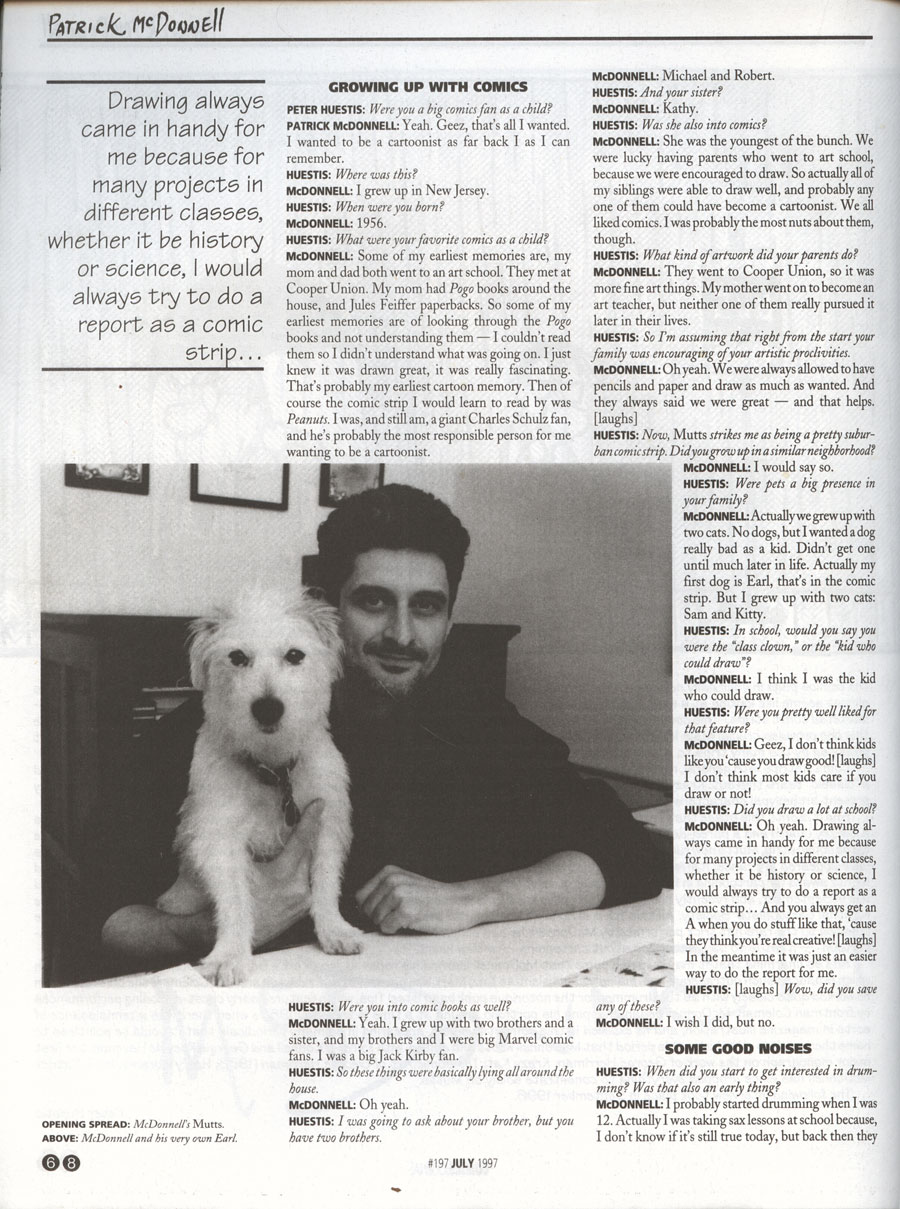
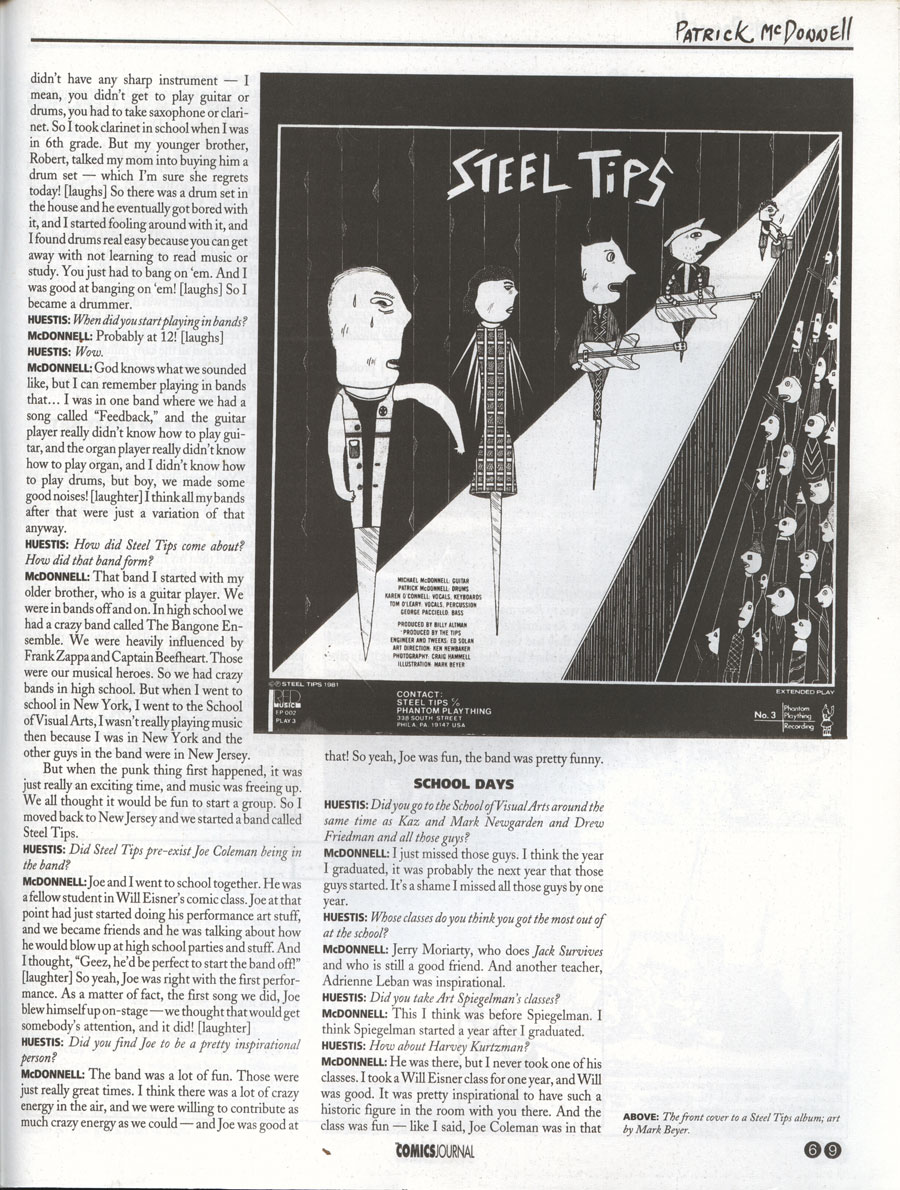
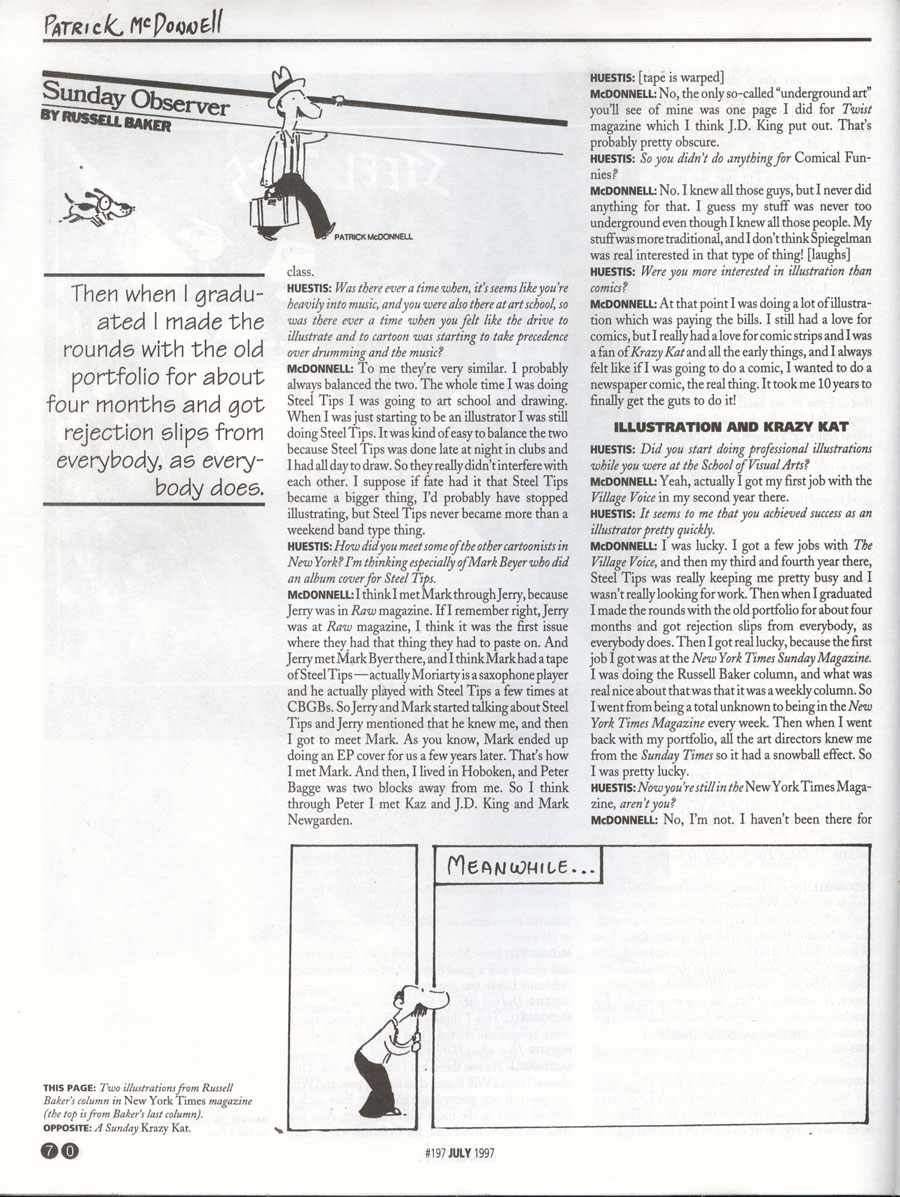
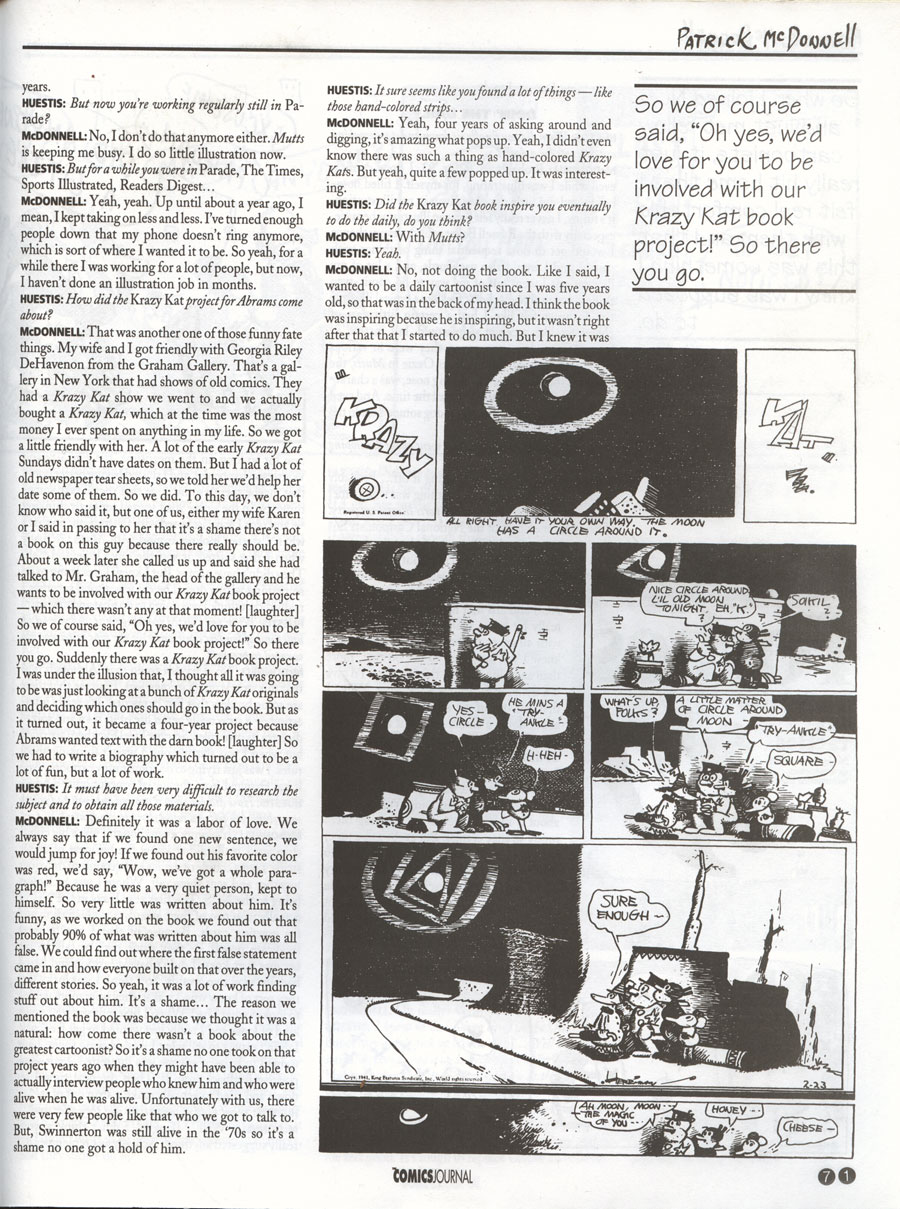
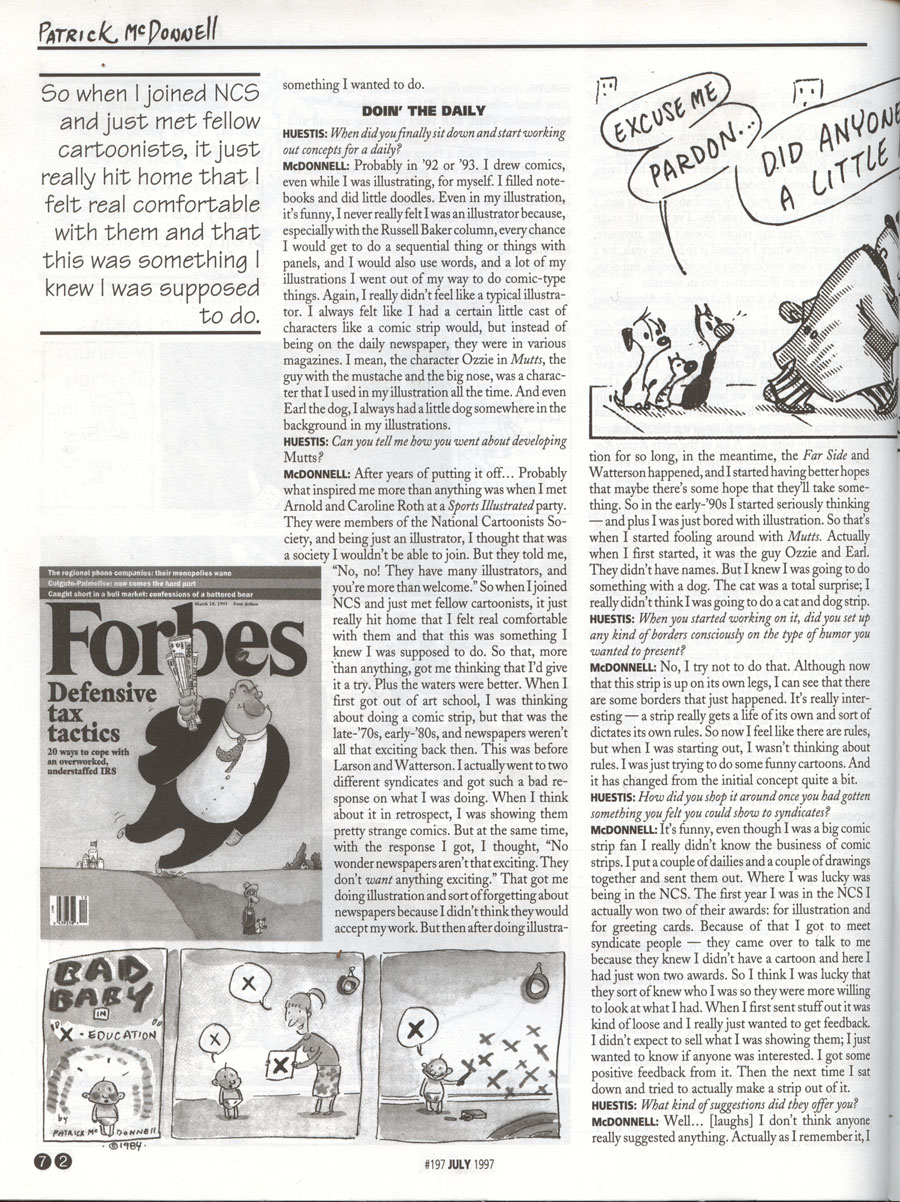
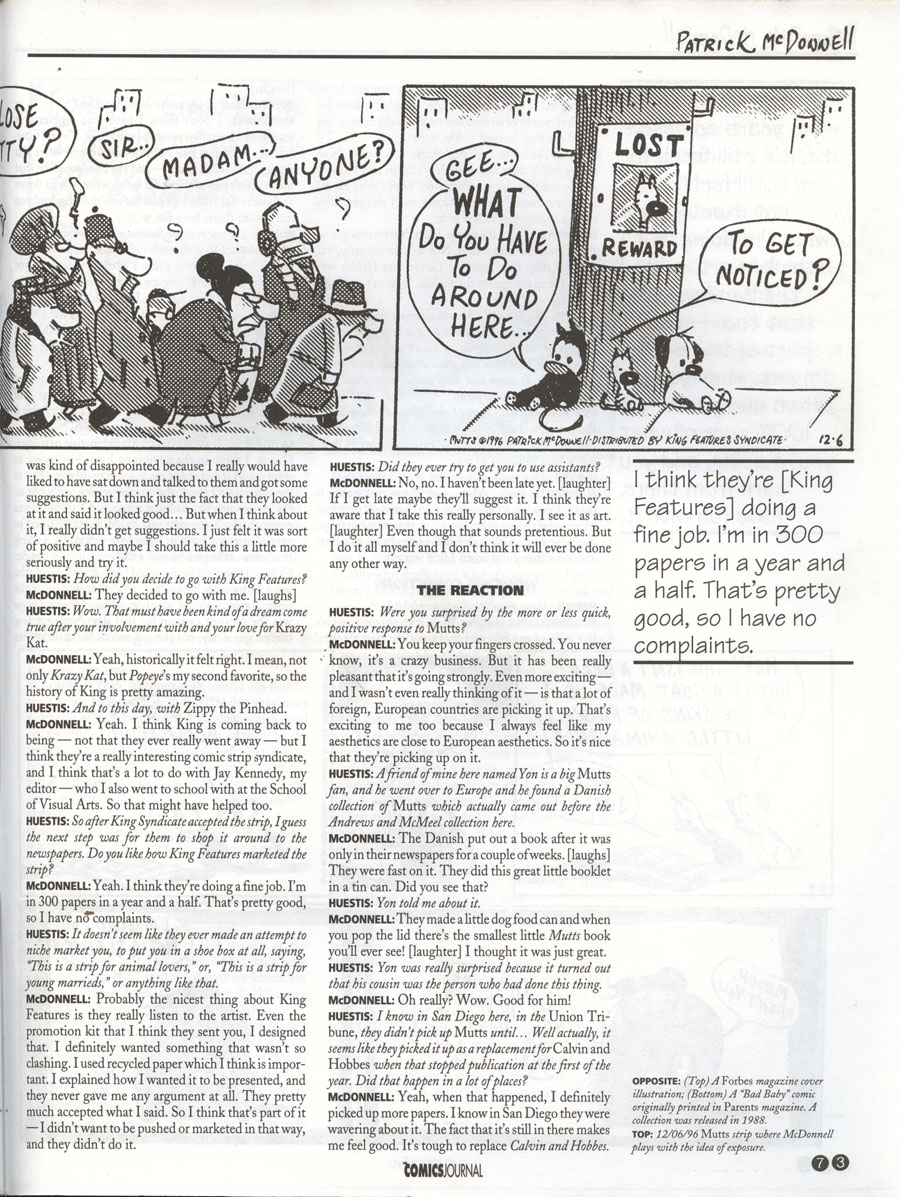
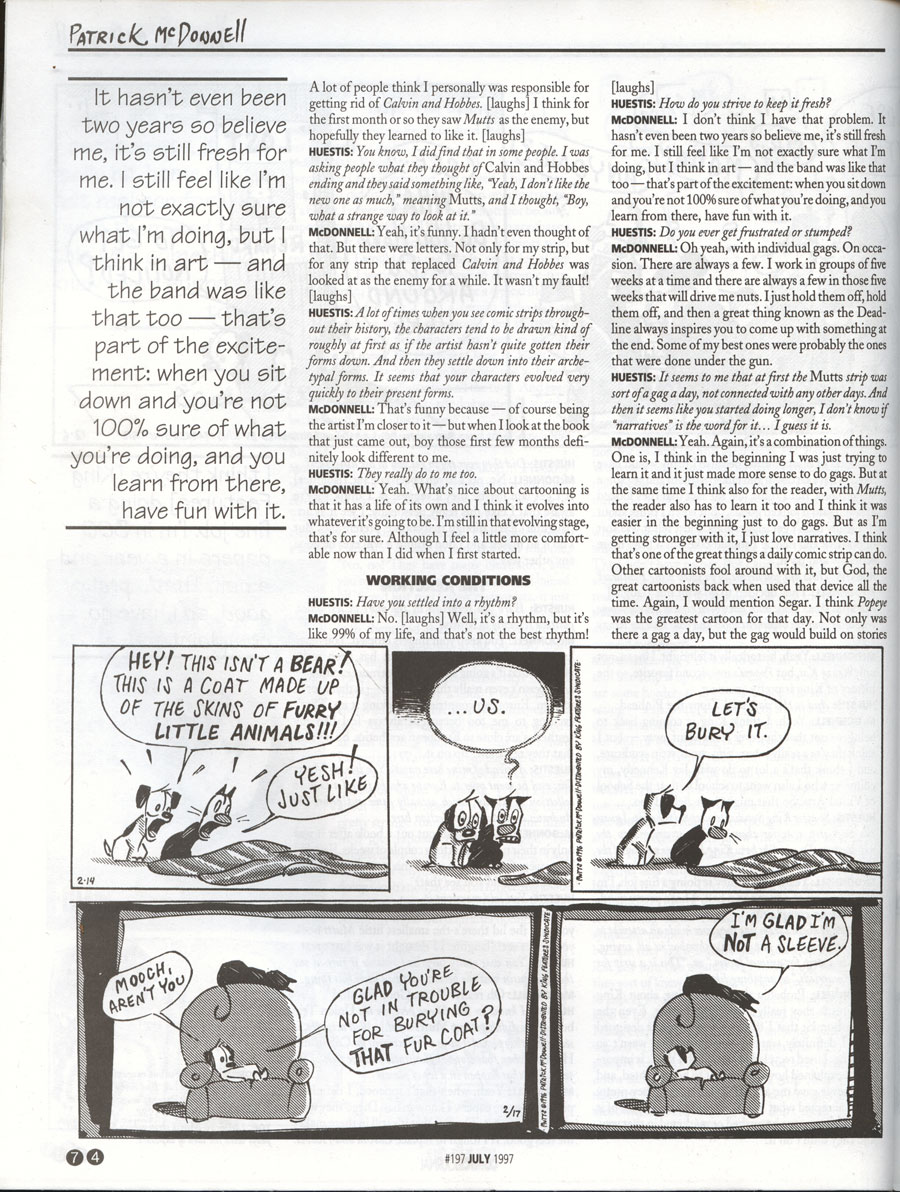
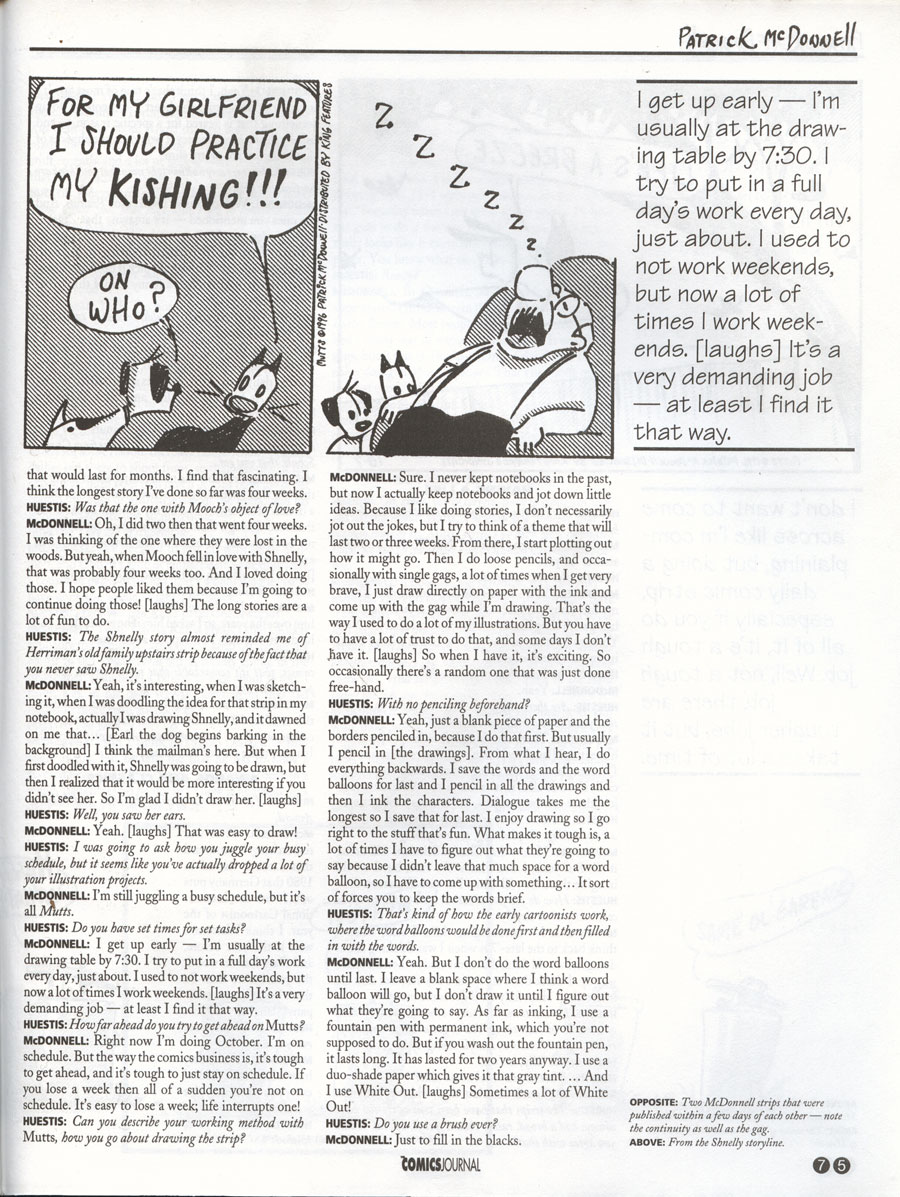
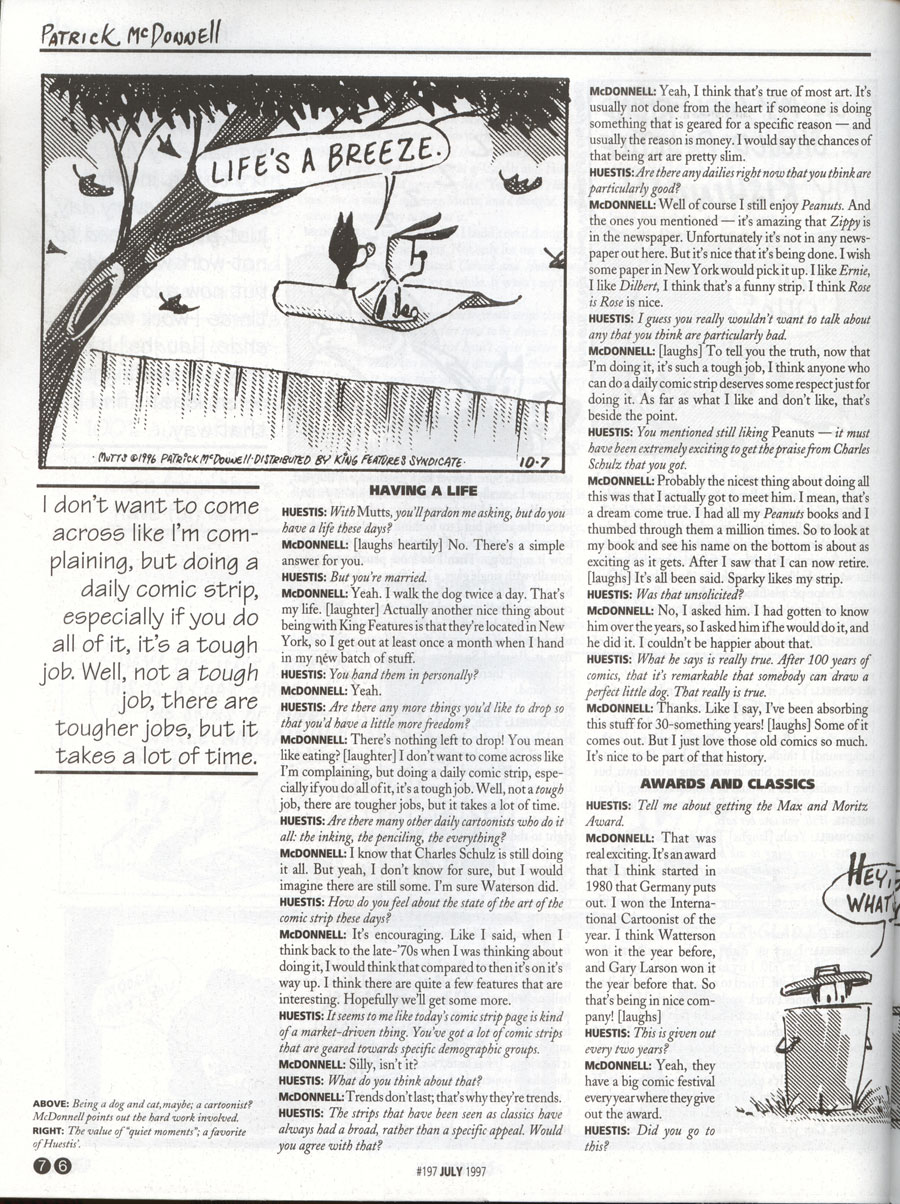
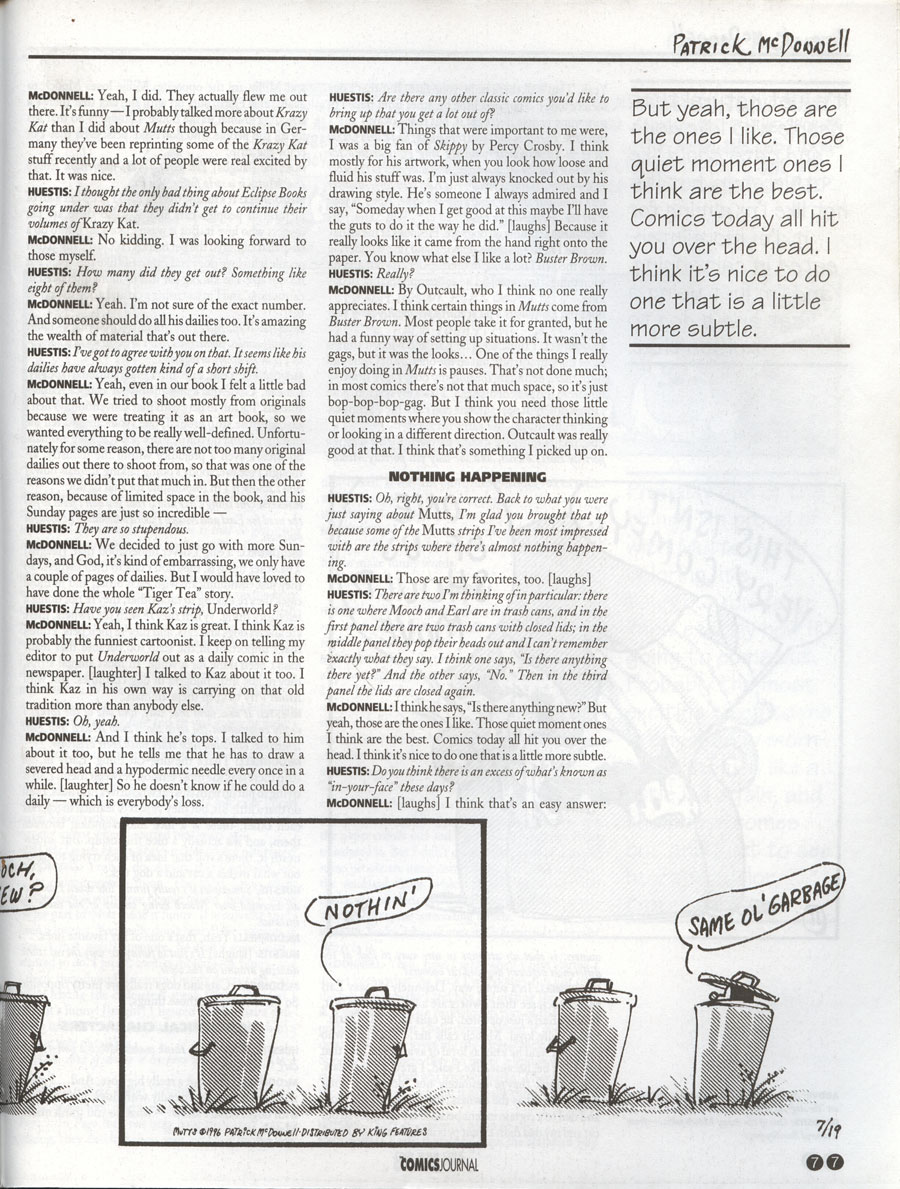
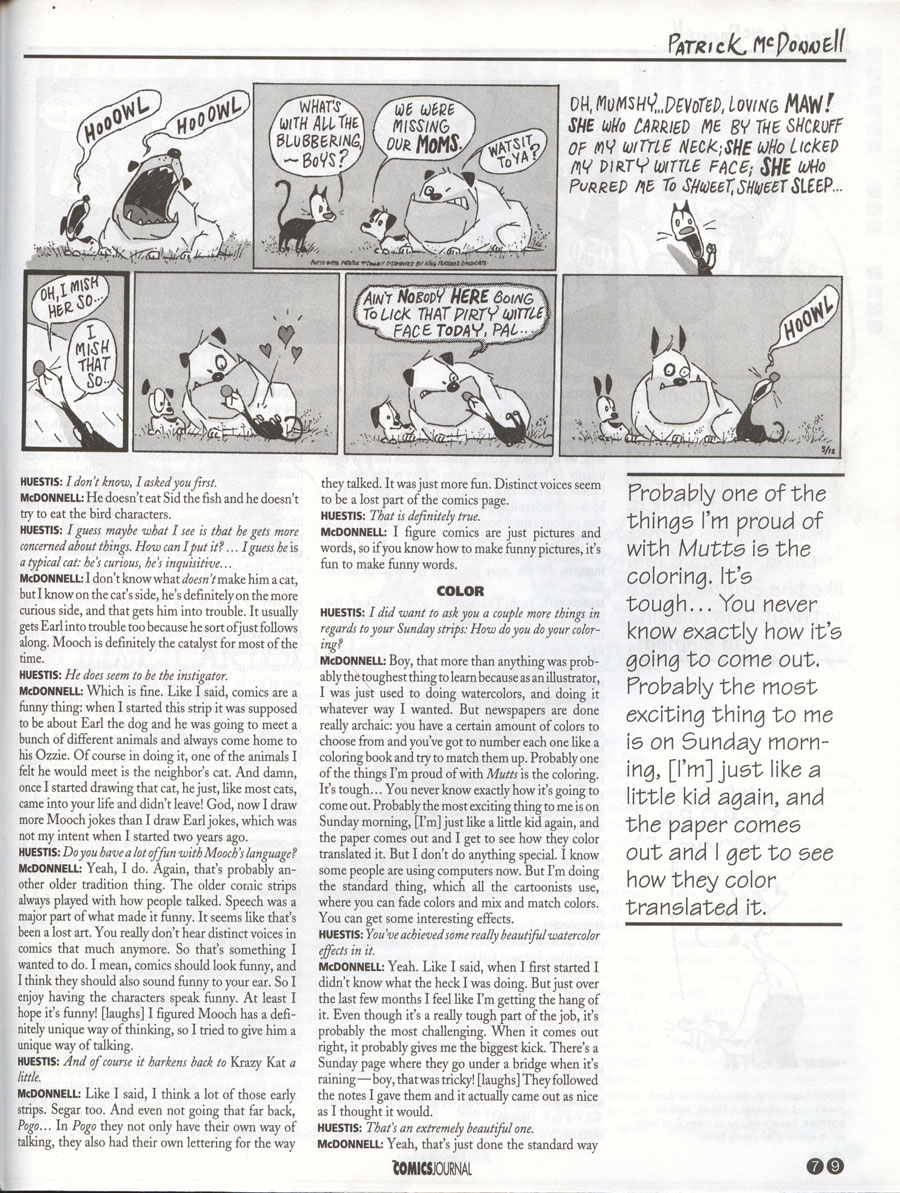
I conducted this sprawling interview with Patrick McDonnell in September, 1996, when his superb daily comic strip, Mutts, was barely two-years-old. It was published in Fantagraphics Books' Comics Journal #197,  July 1997. I've always been an obsessive fan of newspaper comics, the Great American Art Form, and when Mutts debuted, I immediately recognized it as an example of the form in its purest state. Fantagraphics was initially dubious; they almost never, at the time, acknowledged the existence of newspaper strips, and I clearly remember that Fantagraphics muckety muck Gary Groth had never even heard of McDonnell, although the young strip was already a huge success and McDonnell was already an acclaimed illustrator and cartoonist. Eventually, however, they agreed to run the interview, and were a joy to work with after the amateur hour I had endured at low-rent Hypno Magazine. This was by far the longest, most thorough cartoonist interview I ever conducted, and it was great to be given the space to cover every aspect of McDonnell's career, from his childhood to his time at the NY School of Visual Arts, his success as an illustrator, his co-authorship of the first major monograph on George Herriman's Krazy Kat (still available!), and even his short-lived career as a punk rock drummer in the band Steel Tips, fronted by artist/wild man Joe Coleman. I'm very proud of this interview, and it may be, if I don't say so myself, the most in-depth look at what it's like to be a daily cartoonist you'll ever read. Each of the pages below may be clicked on for a readable enlargement. Enjoy:


Monday, January 03, 2011

Reprint: A Frank Discussion With Jim Woodring, 1995

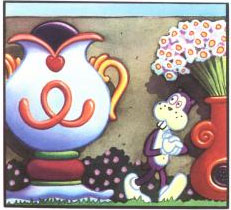
I conducted this interview with Jim Woodring for Hypno Magazine in the mid 90s, just after the success of his "Frank in The River" issue for Tantalizing Stories, the collected Book of Jim from Fantagraphics, and before the release of the first volume of collected Frank stories, also from Fantagraphics. I wanted the interview to be specifically about Frank, the cute yet enigmatic anthropomorphic star of his largely wordless allegorical wonderland. Jim and I conducted this first as a telephone interview, and then we both heavily worked over the results for maximum clarity. It was a great experience and I enjoyed working with the imposing but nevertheless lovable Mr. Woodring. Unfortunately, by the time it was published, the designer and editor of the magazine conspired to make it look like the interview had been chewed up and vomited out by a particularly sick copy of Quark Express, rendering it all but unreadable (as was usually the case with what I contributed to Hypno), so rather than scanning and posting the original pages, I'm transcribing it for this blog. Enjoy:

Peter Huestis: I want to discuss Frank. You told me earlier that you regard yourself as Frank's guardian. Could you elaborate on that?

Jim Woodring: I have such a sense of protectiveness towards Frank that I feel it's necessary for me to shield him from as much as I can. As he moves through the world I make things happen to him, and I have to be careful of the way I treat him. But beyond that I feel that he is such a citizen of the cosmos that I can't own him, and I couldn't sell him. He's not simply mine to do what I want with. I have an obligation to protect him.

PH: An intriguing aspect of Frank's design is that there's a tension between his "cartoony" and realistic features. His teeth, for instance, are often quite detailed, whereas the rest of his features are very generalized.

JW: There are times in comics when I like to get specific and portray something with a kind of unpleasant, clinical precision, for effect.

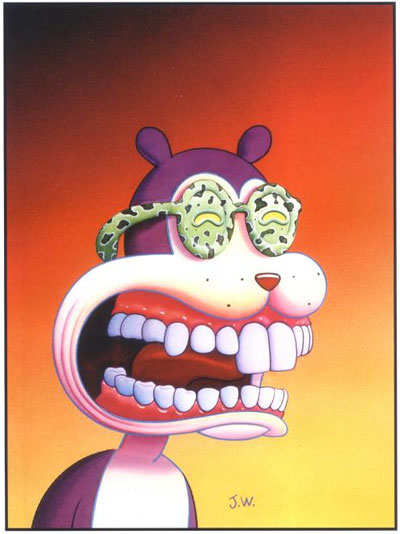
PH: You really played that up in the Frank cover for the first volume of Jim, where a pencil is lifting his lip up, revealing detailed dentition.

JW: Right. When I drew that I hadn't any idea that I would make him a regular cartoon character. I had the idea for him as an emblem, not a character. But when I needed a character, there he was.


PH: Many of your stories are based on dreams. Are there certain dreams that become Frank stories?

JW: No. I never use any of my dreams in the Frank stories. I've evolved a way of writing those stories that I adhere to pretty much all the time. I go down into this ravine near my house and hide in the bushes and write in my notebook. I write the stories out in words. I'll write an opening line like, "Frank has a heavy heart." If I like that for an opener, I will ask why he has a heavy heart. Sometimes I get an answer and sometimes I don't. Sometimes an answer comes and it doesn't make any sense, like "Frank has a heavy heart because fire has burned up his landscape," and nothing else comes, so I just have to drop it. But eventually the whole story comes to light, like pulling a necklace out of the mud. I have a sense of trying to capture it as it comes by, or shine a light on it as it slithers by, more than writing it. I fish for ideas and then I test them against my... uh, whatever critical faculty I use for this stuff. If they work out, I just put 'em together and don't worry about what kind of sense it makes.

PH: But Frank does seem to inhabit a fairly consistent universe with its own internal logic. How would you describe Frank's world?

JW: Frank's home is basically the world as I saw it when I was a kid, and as I still believe it to be, which is a living, charged-up field of states where everything has meaning. It's really the main character in the stories. Frank himself is not that interesting. Frank and Manhog and all the others exist to describe the nature of that place.

PH: Frank's actions appear to be primarily motivated by curiosity. Would you agree to that?

JW: Yeah. Frank is innocent, but he's also ignoble, like a child. He's curious, but he's also motivated by self interest. He's innocent but not divine.

PH: What else motivates Frank?

JW: Desire for harmony, desire to find out about himself and the universe around him. Desire to enjoy life.

PH: Manhog, on the other hand, also seems to be driven mainly by curiosity, but of a more greedy, envious nature.

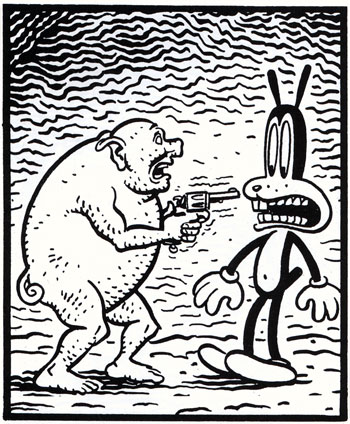
JW: Right. Manhog is composed of negative personality traits. He's greedy and cowardly, and he's got no dignity whatsoever. One of the important issues about Frank is that he doesn't really have any visible source of support. He lives in his house, and he's evidently incapable of making a living. There's really a sense that he's been provided for... that a house has been given to him, that food is given to him, and that he's led into certain circumstances which are intended to educate him. Manhog is the same way: he's plainly a charity case, too. He can do nothing for himself. They just live in this landscape which manipulates them, which is basically the way I see life. I'm really dismayed at how little control we have over our own lives, and that's the central issue here.

PH: Frank and Manhog's relationship isn't entirely antagonistic. What can you tell me about their relationship?

JW: It's symbiotic. I think they're both such pure beings that you're unlikely to encounter anyone like them in the here-and-now. They represent two sides of a whole. I know when I think of Manhog as my father, upon whom I based him, I see myself as Frank in that relationship. But when I think of Frank as being like my son, I see myself as Manhog. What they are has less to do with personality than with state.

PH: How would you describe the difference between personality and state?

JW: Childhood and adulthood are different states; you and I have different personalities.

PH: Another interesting contrast between Frank and Manhog is that Frank comes across as a humanized animal, whereas Manhog comes across as an animalized human.

JW: I hadn't thought of that, but that's exactly correct. I like animals a lot; I think they're more attractive than humans in a lot of ways. What's good about Frank is what's good about a contented animal. What's bad about Manhog is what's bad about mankind.

PH: There are several other recurring characters in Frank's world. First of all, there's... I believe his name is Pupshaw?

JW: Yeah. Her, actually – it's a female. She was in a abusive relationship with one of the Jerry Chickens, which has given her a peppery attitude. She is, on the one hand, like Frank's dog: She's completely loyal to him, and he can abuse her out of frustration and she'll always adhere to him. On the other hand, she's also one of his prime protectors and guardians. She's much more powerful, and much more attuned to the tough world than Frank is. She makes herself subservient to him.

PH: Frank found Pupshaw at a yard sale run by a strange, pyramid-shaped chicken ["Frank acquires Pupshaw"].

JW: Yeah. That's one of the Jerry Chickens, the one that had the abusive relationship with Pupshaw. There's four of them. I've only shown three, but there's four.

PH: Tell me more about the Jerry Chickens.

JW: They're just chickens that have very simple geometric shapes. There's a cone, a cylinder, a sphere and a cube, and they live together in a house that looks like those individual coffee decanters they bring you in restaurants. They're all kind of rough-and-tumble sorts... soldiers of fortune.

PH: How about the long-faced man?

JW: That's Lucky. He's a human being who is being forced to live there as a punishment. I'm not sure what he's doing there, but he's not like the others. His face has been distorted to further punish him, and to prevent him from talking.

PH: And how about that bird character with the sharp beak?

JW: That's just a scary bird.

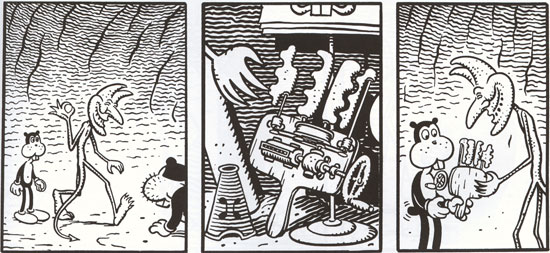
PH: One character who made an appearance in Tantalizing Stories #5 suddenly becomes very significant in the new Jim Vol. 2 #3 ["Frank's Faux Pa"]. I'm talking about the crescent-headed man.

JW: Right. He's had a few names. First I called him Scratch, and then I called him Bandini for a while, and now I'm gonna call him Whim, because he's a cold-blooded opportunist. He's the political creature among them. He wants power.


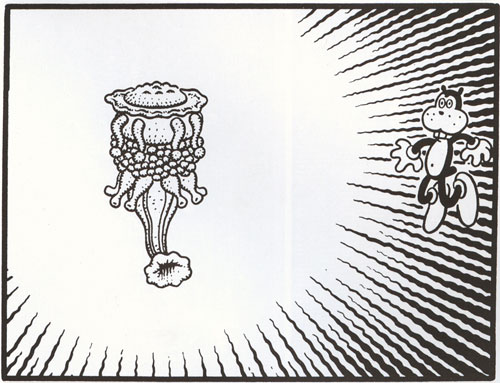
PH: Some of the most pervasive characters in the Frank stories, and also the most enigmatic, are the spindle-shaped objects.

JW: Those are Jivas, conditioned souls.

PH: There are a lot of them in Frank's world.

JW: Yes, there's lots of them... a lot of ghosts. To my way of thinking, there's a lot of them everywhere. Frank can see them and ride on them, and so forth.

PH: In "Frank and the Truth about Plenitude," in Tantalizing Stories #6, Frank hitches a ride on a Jiva and goes to a sort of temple on a mountain. He ties down the Jiva, goes inside, and looks at some portraits...

JW: They frustrate him. That place that he goes to is some human being's getaway, and someone has stashed some Dutch paintings there. Frank goes there, and he's attracted to the paintings, and he puts on the accouterments... he tries to dress like the people in the paintings, and he has a glimpse of what it's like to be human, but it's just a glimpse. He feels so powerful on this delusionary wave that he tries to grab the stars out of the sky, but he can't do it, and that frustrates him so much that he abandons the idea of being a human being entirely, and he throws all the human trappings into the water. But then he sees that there's something in the lake that's lighting the whole lake up. He jumps into the water, and the light is flashing off and on, and as he's swimming toards it, he sees that it's like a bomb that never stops exploding. So, even though it's dangerous and volatile, and always blowing up, he can get near it, and as he does, he sees an elementary radially-symmetrical life form. It's a medusae. That provides him with the answer that he's looking for, as far as his relation to the human goes. He realizes that he's been greedy in his spiritual aspirations, and has been misbehaving in enslaving this Jiva. So he liberates the Jiva, and goes back to appreciating the paintings for what they are, as opposed to allowing himself to become jealous.


PH: There are many jars in Frank's world.

JW: Yeah, well, they're just containers to hold things. Frank's world is very materialistic, and most of the catalysts that one comes across are objects, and they need to be contained and they need to be hidden, so there's lots of jars around.

PH: I'd also like to ask about the architecture of Frank's world.

JW: I like emotional, devotional architecture where the shapes and proportions seem to reflect the personality of the cosmos. I know nothing about architecture, but it seems to me that there is a strange anthropomorphism in Moorish architecture, where human states are symbolically represented in abstract ways that need no interpretation. I'm trying to do something similar in my groping clumsy way.

PH: In the latest Jim, the color Frank story ["Authorized Only"] leaves the reader in a lurch because it's "to be continued." It also leaves the reader a little concerned for Frank's well-being.

JW: That's almost dishonest on my part, because I'm not sure that strip will be continued. If it is, Frank is lifted out of the place where he is and replaced back where he ought to be, and his shape is restored.

[Note: in later reprintings, the "to be continued" text is removed.]

PH: So Frank has trespassed...

JW: Correct. He rode on the back of a Jiva, and he sneaked into a place where he did not belong.

PH: How about the other Frank story in the same issue in which Frank and Manhog procure food ["Frank and Why it's Good to be Clever"]?

JW: I just wanted to show in that story that Manhog doesn't stand a chance in hell of ever having a normal or happy life. He's mostly ineducable, but the story showed him actually learning how to get a piece of fruit out of its shell. The first chance he has the opportunity to put that into effect, he picks up what is not a fruit, but an animal. And so, his newly-learned skills work against him, and it rouses this animal's ire, and it punishes Manhog. There a page in that story that's flopped.

PH: On the fourth page of the story. It only breaks down at the bottom, though.

JW: It kinda impedes the flow of the story.

[Note: this has been corrected in subsequent reprintings.]

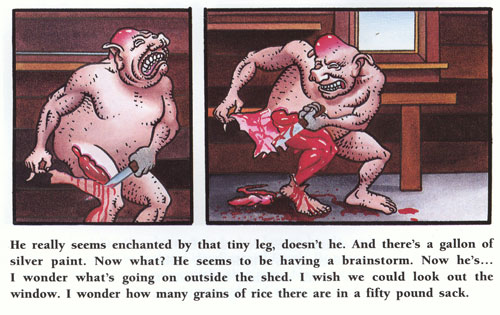
PH: I guess that's the hazard of the wordless Frank stories. Speaking of which, in Jim v.1 #1, you did one with text underneath the drawings ["Manhog Beyond the Face"], and judging from your letters page, it irked some of your readers.

JW: Some people didn't like it. The reason I did it was because I had done those pages for another magazine with differently proportioned pages. When I ended up running them in Jim instead, I had a lot of dead space either at the top or the bottom. So I just ran the words there to fill up the space.

PH: I enjoyed the writing because it had a Highlights for Children feel to it.

JW: [laughs] That's exactly what I wanted!

PH: Until, well... why don't you tell the story?

JW: Manhog receives such a wallop to the head that he's not in his right mind. Inspired by a fragment of a sports trophy, he carves all the skin off one of his legs and paints the exposed muscles with silver paint.

PH: At which point the narrator...

JW: Just looks away. He's turned his head and is looking out the window. The reason I did that is because I had become acutely aware, through dealing with my son, that adults have one view of the world, and they tell children that the world is something else. So when I was writing this dialog... It's a pretty horrible story, but it's couched in very positive terms: "Oh, Manhog sees the little bird. Oh look! He threw a rock!" What's happening is terrible, but it's candy-coated in the text. When it reaches the point where there's no nice way to say, "Oh, he's butchering himself," the narration simply breaks down and starts talking about something else. I was thinking of the way we lie to children, and then shut up when there's no way of lying, or we avoid a point when there's no way of addressing it.


PH: What are your feelings about doing strips in color as opposed to black and white?

JW: I prefer the color stories because they can have much more emotional and psychological depth than the black and white ones, but I'm seldom happy with the way they reproduce. On the other had I have a much greater romantic attachment to pen and ink than to watercolor, because of the pen's traditional use in cartooning and because it is such a difficult medium to master.

PH: I love the blue line you use around Frank's features. You told me before that it lends Frank calmness.

JW: I wanted him to be pretty. I wanted to have to self-color, as they call it in animation, because I thought it would link the characters to the background in a nice way, and it offers yet more ways of expressing emotion. But yeah, I wanted Frank's colors to be cool and calm and harmonious. He's also purple and white, which is the most ugly color combination in the world, and my high school colors.

PH: I just remembered another object: In Jim v.2 #2, Frank visits the House of The Dead and encounters a rattle-like object with a face painted on it.

JW: Right. Those are actually offered for sale in the current issue of Jim. I'm selling them now.

PH: What can you tell me about this object?

JW: Well, you got it right – it's a rattle-like object, but it doesn't rattle, and you make it peer around corners. That's its function. The purpose is to upset people. It's best if you can do it a lot before they see it. The thing is to be peeping and looking at people for a long time without them seeing it; then when they do see it, at least in theory, it will get under their skin a lot more. The point: to give anybody who has it the power of taking on the aspects of a silent mocker, which can be hard in everyday life.


PH: How do you feel about all these stories being collected in a all-Frank book?

JW: Oh, I'm all for it. It's hard for me to look at my stuff because when I pore through it, all I see is a collection of mistakes. But I'm really happy that it's going to come out as a book. In fact, I just oversaw the last bit of it as it was going off to the printers today, and I'm real happy with it. The cover has some computer modeling done by Mark Landman, and one particular thing he did is my favorite color object I've ever seen anywhere. It's this one border around a picture in the middle of the book. It has the most perfectly beautiful combination of colors I think I've ever seen.

PH: I was surprised that you had someone else color your latest Frank story. What led you to having Mark color it?

JW: For one thing, my color work is tricky to reproduce, and I knew that by having Mark computer color that story, I would be able to predetermine the way the color would come out. In the story in Jim v.2 #1 where Manhog skins his leg, the colors shifted so radically from the original, and not in a good way. There's a body of water near the end, and in the original art it was blue/green, a real aquamarine. The way it came out printed it looks like a pool table. It destroyed the emotional impact of it. It doesn't look like he's diving into a pool of nice, cool water, but like he's diving into a pool of opaque green paint. That kind of stuff really upsets me, when the emotional content is affected. I also wanted to work with Mark because he's the best guy I know out there doing what he does, and I wanted to have him do it because I wanted to find out more about computers. I'm really, really happy with the work he did.

PH: What do you have in store for Frank next?

JW: The next issue of Jim is going to be all Frank, and then there's a long, long story in the next Whole Earth Millennium Catalog ["Frank's Real Pa"], then the collected Frank, and then Kitchen Sink Press is doing a Frank Christmas card. I'm also working on an interactive CD-ROM for a megaconglomerate in New York, which will have Frank-like aspects to it.

PH: Is this a Jim Woodring CD-ROM?

JW: No, it's a normal commercial project; I'm just designing the look of some parts of it. If it goes, it could be something really nice.

PH: And I have to ask: does it bother you that this whole interview has been about Frank?

JW: No, I love Frank. I love to think about him and talk about him. Nothing I do gives me more pleasure and satisfaction. My life would be poorer if he hadn't come along. What's strange is that so many people assume he is a cat. Take him detail by detail and he is unlike a cat in almost every particular. He looks much more like a beaver, but nobody ever suggests that. It's weird.

Jim's work is certainly easier to find than it was when I conducted this interview. Several volumes of the collected Frank stories are available from Fantagraphics and elsewhere, as well as his well-received recent graphic novel, Weathercraft. Many more wonders to behold can be viewed on Jim's website and blog. Get into Jim Woodring!

Related: Interviews with Dan Clowes and Chris Ware.

Saturday, December 11, 2010

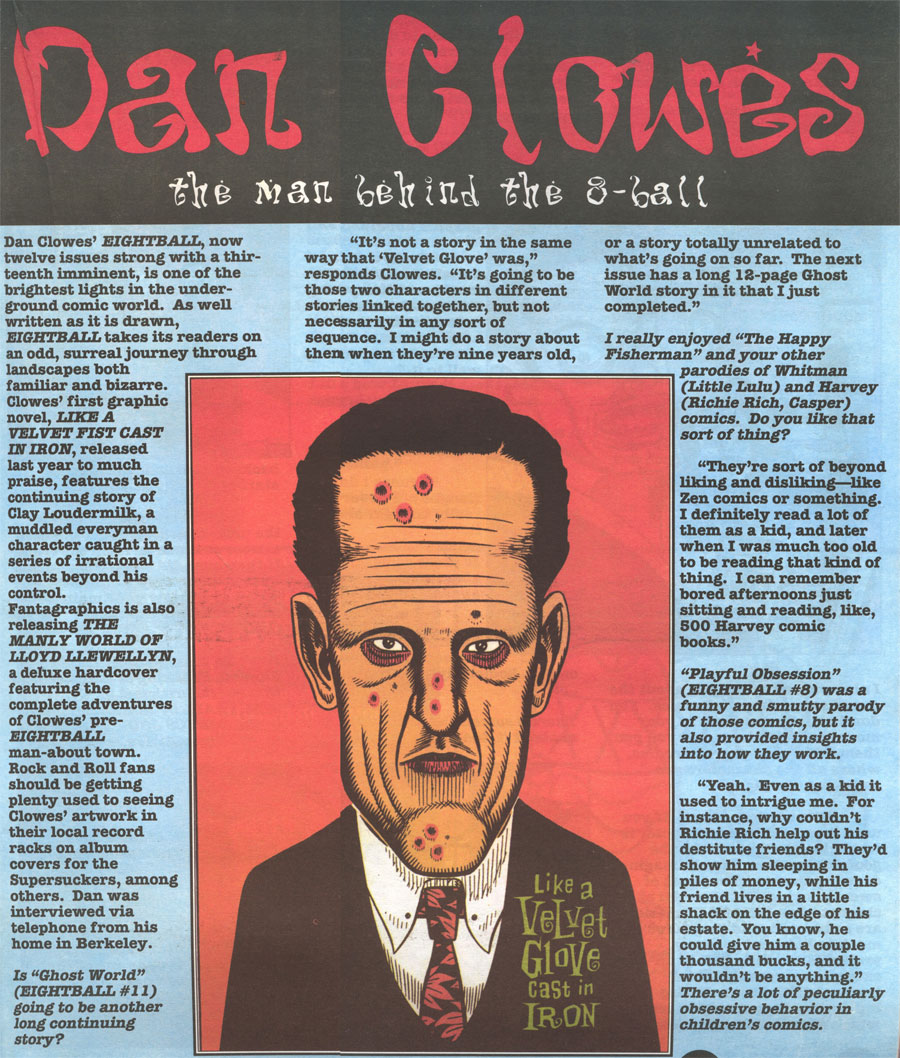
Reprint: Interview With Dan Clowes, 1994

I published this interview* with cartoonist Dan Clowes in Hypno magazine in 1994. Clowes, at this point, was between issues #12 and #13 of Eightball, and had just begun the "Ghost World" series which would be made into a movie seven years later. What's really interesting here is how foggy his conception is of how Ghost World would develop. Other topics of conversation include the weirdness of Harvey and Whitman Comics,  the use of sweat drops in cartoons, his earlier series "Like a Velvet Glove Cast in Iron," and, prophetically, whether or not he could see himself writing for live action film ("Possibly.").

Click each for the larger, readable scan:


RELATED POST: Interview with Chris Ware, 1995.

*Is anybody interested in more of these? Because there are plenty: Jim Woodring, Diane Noomin, Charles Burns, Mark Beyer, and a mammoth, lonnnnng interview with Patrick "Mutts" McDonnell conducted for The Comics Journal.

Friday, March 19, 2010

Reprint: Article on Big-Eyed Art, 1995

(Click all for bigger)

I'm going out of town for a long weekend, so I'm leaving you with this, a cover feature I wrote at the height of my obsession with big-eyed art in the mid-1990s. The cover features elements by Paul Mavrides composited (badly!) by Frank Kozik.  This was a fun feature to work on, and I was thrilled to interview some of my favorite artists for it: Bill Griffith, cartoonist auteur of Zippy the Pinhead; Dan Perkins, better known as Tom Tomorrow; extraordinarily talented illustrator Mitch O'Connell, who frequently includes Gig's "Potato Chip" in his work; and John Waters, who should require no introduction here. Enjoy.


Note: I no longer believe the story about Walter Keane "stealing" the idea of painting big-eyed children from his crazy wife, nor do I believe she painted his works for him. I'll write more about this bizarre case later.


Tuesday, January 12, 2010

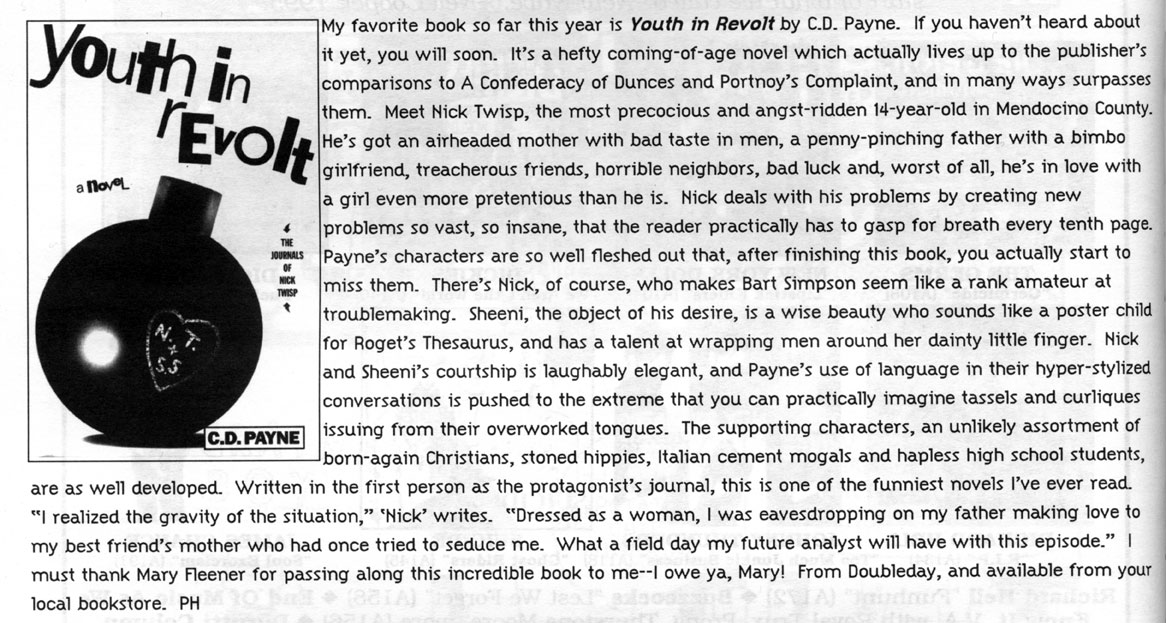
Reprint: Review Of C.D. Payne's Youth In Revolt


Click for bigger.

In 1994 I read a new novel, one which was quickly amassing a cult following, called Youth in Revolt. I liked it a lot, and reviewed it (see above) for Hypno Magazine. It's not a very well written review, but I stand by it. I certainly recommend reading the book.

I haven't seen the movie because I just can't believe Michael Cera, good as he can be, can do justice to the Nick Twisp character.