Sunday, May 27, 2012

Single-Panel Comics By George Herriman And Paul Fung, 1930

(Click each for larger version)

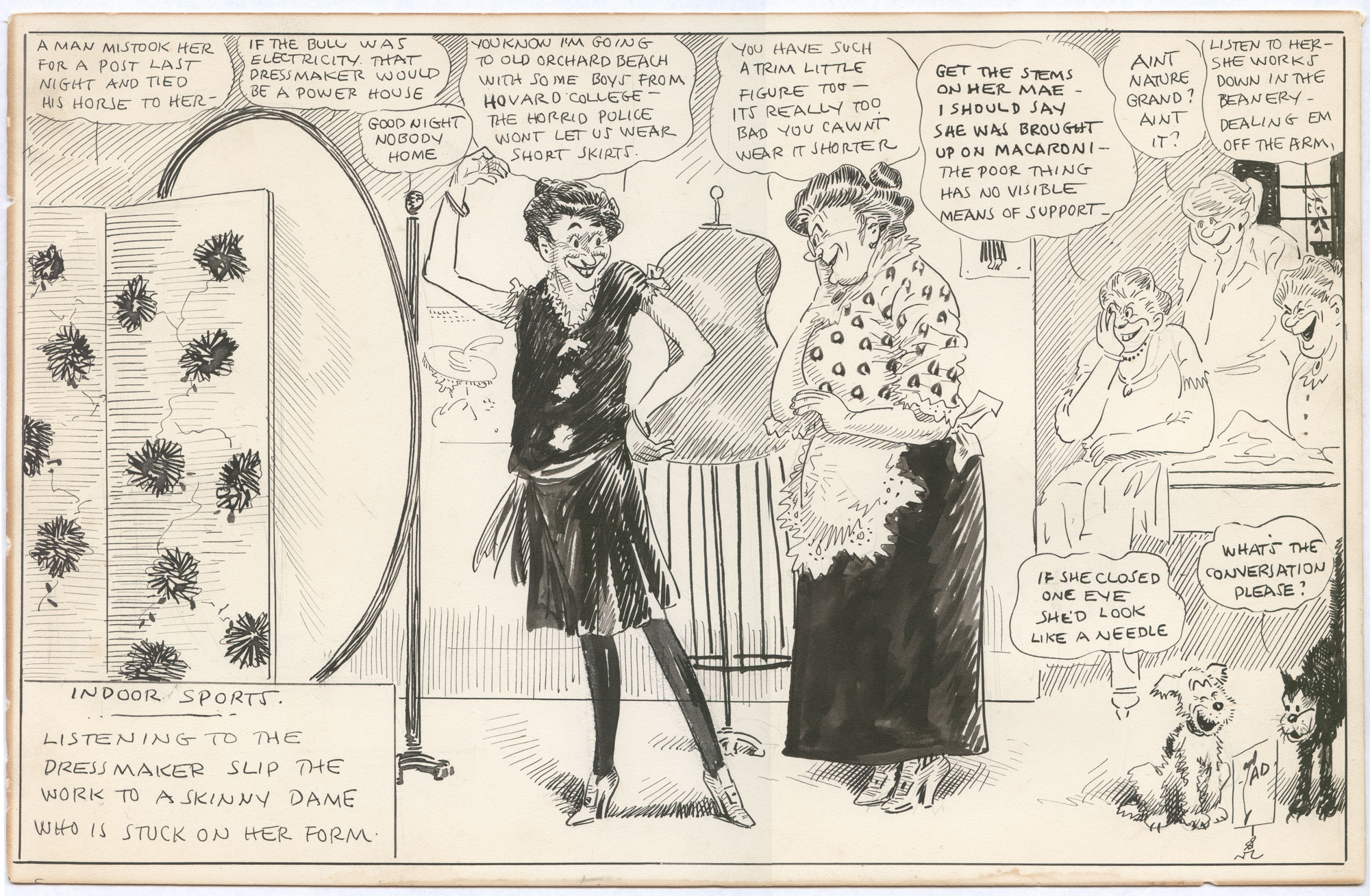
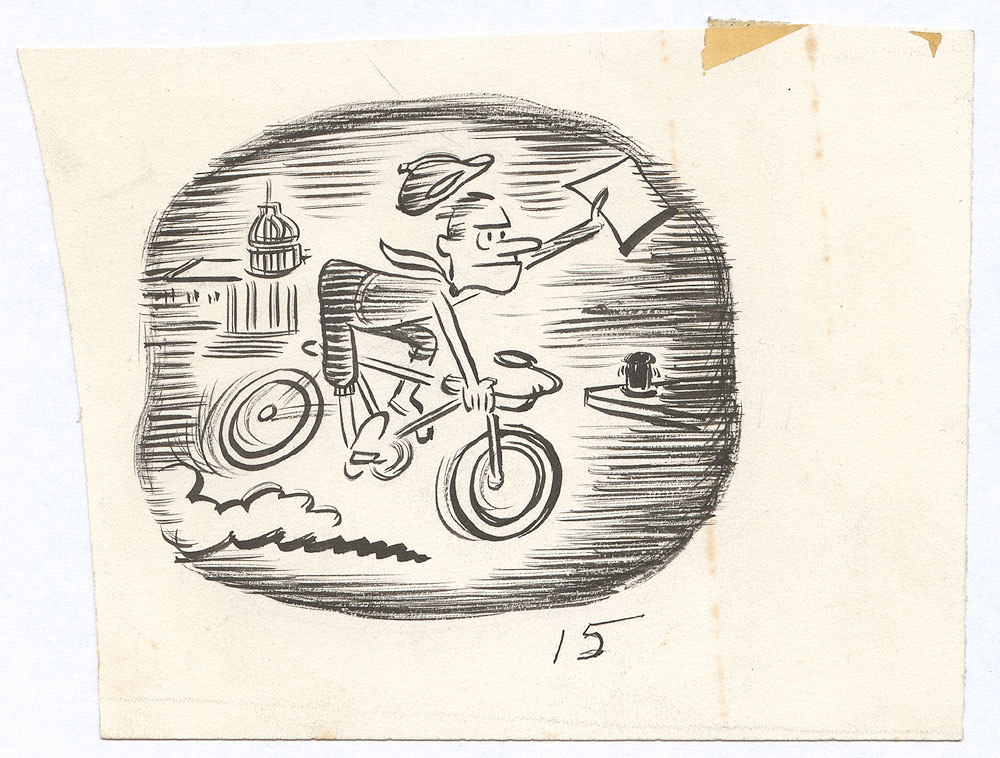
Recently I picked up a massive cache of over 1,000 (gahhhh!) comic strip clippings from the San Francisco Call-Bulletin from the late 20s/early 30s. About 96% of them are the work of Jimmy Hatlo, and I've already featured some of those here. Hidden amongst the Hatlos were a few comics by other artists, and these four are my favorites. First up are two rare examples of the great George Herriman's seldom-seen Embarrassing Moments panel feature. Herriman drew this low-key daily for a few years beginning in 1928, concurrently with Krazy Kat. I suppose this was his attempt to do a more mainstream, popular feature, similar to his friend Tad's Indoor Sports, but Embarrassing Moments didn't seem to ever gain much traction. Too bad, because the drawings were, of course, wonderful:


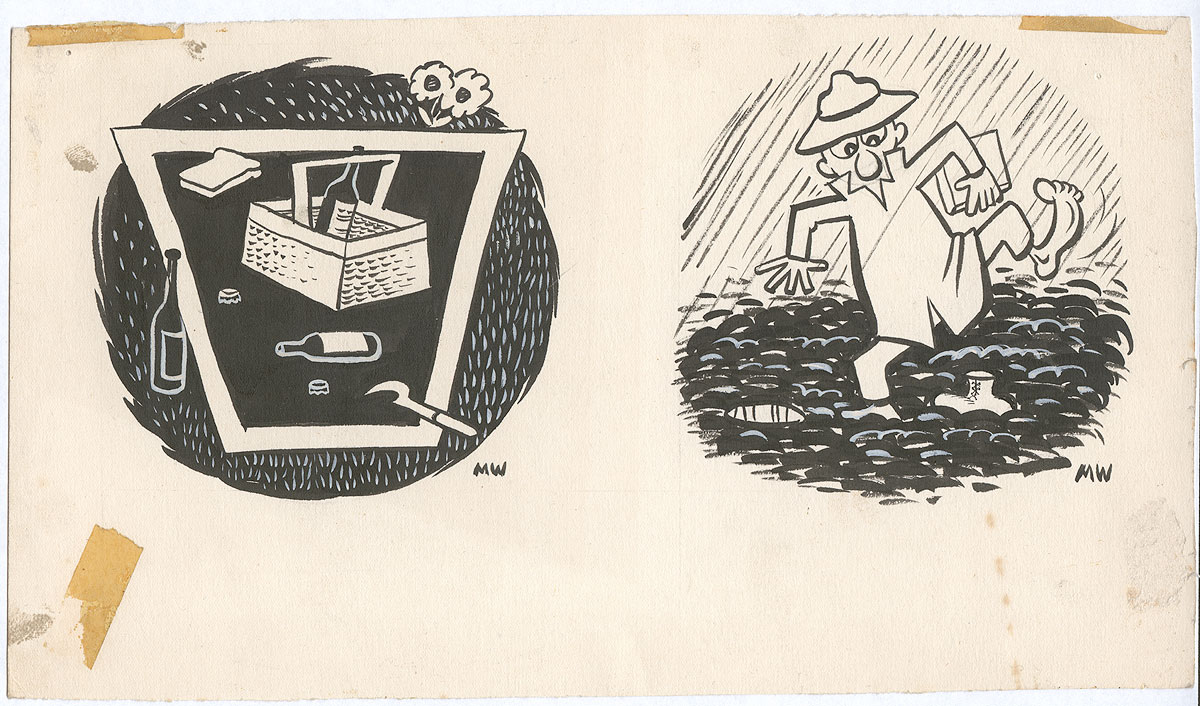
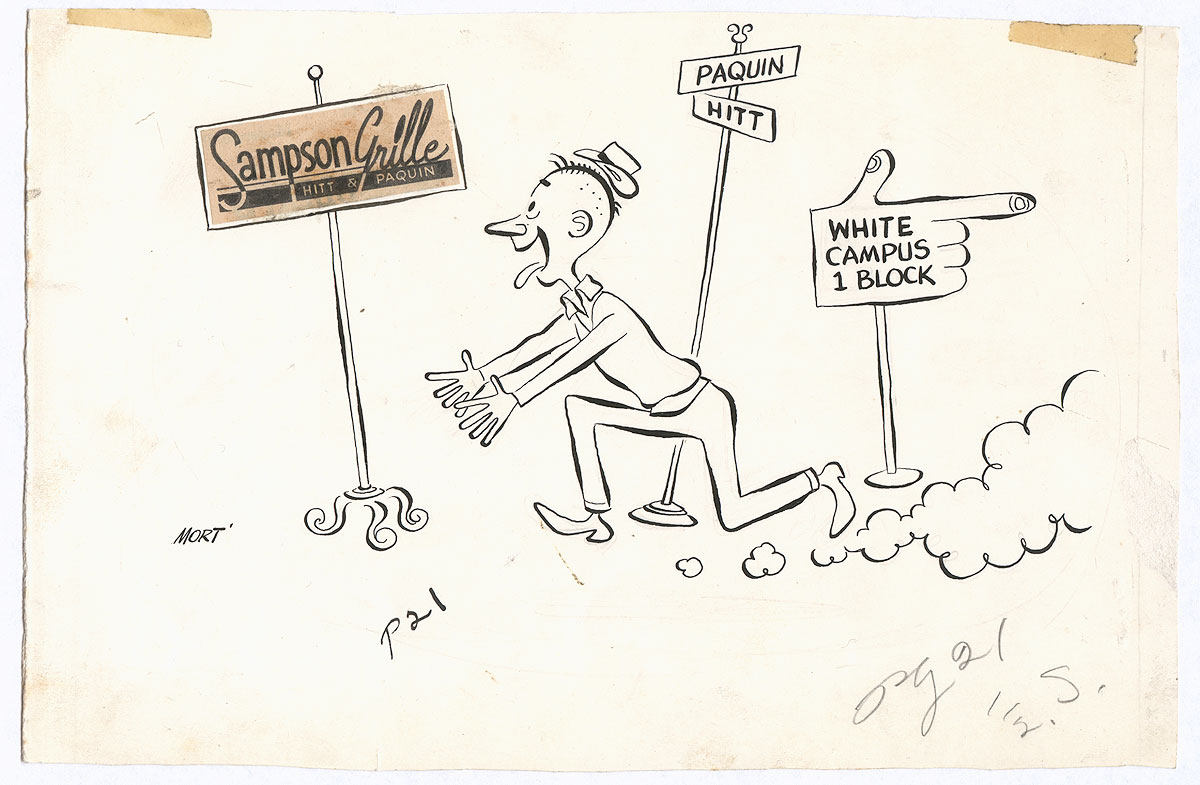
Next up is something even more obscure, two Bughouse Fables panel gag cartoons drawn by Paul Fung. This feature was apparently invented by Barney Google creator Billy DeBeck in 1921, and later handed off to Fung, his assistant:


I had never heard of Paul Fung before, but just in the last week Allan Holtz has posted several items (here, here, here, and here) on this fascinating Chinese-American cartoonist at his endlessly valuable Stripper's Guide blog. Fung is a good example of a journeyman cartoonist, the type employed by the syndicates to assist their better-known feature artists. Basically, there were ten Paul Fungs to every one Billy DeBeck, if you know what I mean. Some of these journeymen ended up as famous cartoonists themselves: Ernie Bushmiller, for instance, started out as Milt Gross's assistant, just as Gross had been Tad Dorgan's office boy (and there you have the connection between my two favorite cartoonists). Li'l Abner's Al Capp learned the ropes on Ham Fisher's Joe Palooka, and later employed Frank Frazetta, of all people, to ink and letter his Sunday Abners. Paul Fung apparently never quite managed to break out of the minor leagues, and judging from these, it's a shame:


There something bizarrely minimalist about the above gag that is immensely appealing to me.

Wednesday, May 23, 2012

Random Arizona Memory

(Tucson High School "Troubadours" vocal ensemble, 1983, at the Temple of Music and Art. The following year, my teen prank garage band played at the same location.)

I was a "choir kid" in high school (see above). It wasn't like Glee or anything; we just stood there in our sweaters and sang (although we did put on a musical every year, a painful ordeal for all involved).

Anybody who was ever involved in anything in high school knows all about field trips to other parts of the state for various reasons, and choir was no different: there were competitions, all-state events, regional meet-ups, etc. Since the major cities of Arizona are far apart (it's a big state!), multiple day happenings always involved staying with host families arranged through the local schools participating in the events.

Now keep in mind that I'm from Tucson, and also keep in mind this unscientific, totally unfair yet basically accurate infographic about Arizona:


Every time we headed north, and particularly when we made trips to Flagstaff or Mesa, there was a certain detail about our staying with host families that had to be discussed, the fact that Mormon households were especially enthusiastic about signing up to be hosts. "Many of you," we were told, "will be staying [dramatic pause] with LDS families." Those who had been through the ordeal groaned, while the newbies looked puzzled. "Be prepared."

Be prepared for what? To be worked.  If you stayed with an LDS host family, you were treated to a non-stop festival of Mormonism, abounding with special "youth activities" which just happened to be scheduled while you were visiting. Meanwhile, the rest of us were attending totally fantastic teen keg parties. The ones I went to in Flagstaff, huge raucous bonfires in the woods, were the best parties I went to in high school. 

The next day, the lucky ones were bleary-eyed, partied-out, and bursting with gossip as we recounted our nights and compared injuries.

"How was your night?" we'd taunt our less fortunate mates as they struggled with their armloads of LDS pamphlets and cassettes, and they would invariably erupt in a kind of post-traumatic, un-Mormon Tourette's syndrome. "Fuck! Shit! Asshole! Fuck! Fuck!" they would shriek while desperately chugging forbidden Coca Cola and unbuttoning their blouses. Then, offended, any nearby Mormon teens would stand up en masse and silently move away from our corruptive vulgarity.

Good times!

I was never parked with a Mormon family. I have a sneaking suspicion that event organizers probably arranged for that. I was, after all, an outspoken atheist and a punk rocker with a penchant for Flock of Seagulls hairdos and garish parodies of resort wear. I also think I was one of those kids who everybody knew was a hairdresser before I did (right?). So I guess in those cases, that worked to my advantage!

So anyway, call me a bigot if you must, because I've heard that it's now chic to pretend that the Church of Latter Day Saints® is not a singularly obnoxious, frequently ludicrous mutation of Christianity, which is obnoxious and ludicrous enough to begin with, but that's my mean-spirited Mormon story of the day.


Tuesday, May 22, 2012

She's The Boss

Now that's more like it! Reuters just published a great story about Herr and Frau Gingrich. It turns out that all of their weird businesses, the so-called non-profits, the healthcare lobbying shop... they've all gone tits-up. All of them, that is, except for Gingrich Productions, which is owned by... Callista!

So that's that for Newt's political career. He's broke. His PAC is broke. His campaign owes zillions of dollars to everybody. But Gingrich Productions lives on! So Almighty Goddess Callista will continue to make weird videos about the Pope and American Exceptionalism, and she'll probably continue her children's publishing endeavors with the unfortunate and disturbing Ellis the Elephant. And Newt? He'll just be a staffer.

So next time they're in Tiffany's looking at fab baubles? Callista will be doing the buying. And isn't that the way it should be?

Friday, May 18, 2012

Excuses, Excuses

Annnnd I'm almost back with you! See, my hard drive died (Didn't lose anything! Always back up!), so I had to take it in for repair. Meanwhile, I was using my older iMac, and that thing has such a wimpy processor that it was making me cry. THEN I started having connectivity problems. So, basically, the interwebs have been a land of wind and ghosts for me for the last week or so. I was barely able to squeeze out that post about the Frederick Opper cartoon!

So anyway, I promise, promise, promise that I want to post new items, but I'm just getting back up to speed. Onward!

Monday, May 14, 2012

Art Collection: Proto Comic Strip By Frederick Opper, Ca. 1890

What a treat. First, the panels (click any for bigger), which have been cut apart and trimmed, and are each about 6" wide, and drawn with pencil, pen, brush, and ink on illustration board:


When was the comic strip invented? That's a tough, unanswerable question, and people have argued over it for decades and will continue to far into the future. It's fair to say, however, that the comic strip as we know it today originated in American newspapers in the mid-1890s, as best exemplified by the work of R. F. Outcault, Rudolph Dirks, James Swinnerton, and Frederick Opper, who are generally credited as being the "four founding fathers" of the medium. These artists combined many elements which already existed, such as sequential picture stories told in panels, word balloons, and recurrent characters, into a popular art form which was unlike anything that had come before.

The piece shown here, The Relic Fiend by Frederick Opper, is a little earlier, and was almost certainly drawn for Puck Magazine between about 1885 and 1895, and as you can see, it's teetering right on the verge of being a comic strip proper. It's really more of a editorial cartoon told in a sequence of several spot illustrations. Because the panels have been trimmed, I have no way of knowing (until I track down a published copy) how they were arranged on the page (or, indeed, if there were more panels which didn't survive), but the bottom panel is inscribed "tail piece" on the verso, which suggests that it was published apart from the others, probably at the bottom of the page.

In any event, what a classic theme! This should be the official cartoon of the Getty Museum. It's an only slightly exaggerated look at the type of American aristocrat, like Henry Clay Frick, John Taylor Johnston, or Peter Widener, who plundered their way across Europe, merrily dismantling altarpieces and wresting sculptures out of niches along the way. And if there was anything Puck disliked more than robber barons, it was Catholics, so Opper managed to get in a hilarious dig at the Pope while he was at it.

Technically, these are impressive drawings, rendered with tightly-controlled pen and brushwork.  The characters are beautifully drawn, and their poses are expressive, accurate and weighty. The high quality and fastidiousness make me place it a little later in Opper's Puck tenure. His earlier drawings tend to be a little wooden, while his later 20th Century work is downright chaotic.

Puck kept Opper very busy, and you can see copious amounts of his artwork from this period, as well as excellent work by other illustrators and stunning, gorgeous color printing, here and here at Google Books. For a contemporary look at Puck, see this painfully antiquated but excellent website.

Later, Opper moved to Hearst's New York Journal, and there he created his best known features, Happy Hooligan, And Her Name Was Maud, and Alphonse and Gaston, all three of which remain fresh, funny, and relevant today, as does the earlier editorial cartoon shown here.

Please Stand By...


Oops, sorry. I know I haven't been a very prolific blogger lately, but I've got computer woes again, so I'm a little hamstrung. I'll be back with more hairdos and obscure 30s gag cartoons before you know it!

Topic for discussion: whatever happened to Apple quality?

Thursday, May 10, 2012

Quickie: Ken Hutcherson: So Gay

(AP Photo, 01-23-12)

Biblical lawn sprinkler Ken Hutcherson wants to take back the word gay. He also wants the rainbow back. For Jesus.

Here's my proposal: Ken, you can have gay and the rainbow as long as you take the pink triangle, too.

Deal?